

NTCA raises alarm over 42 tobacco industry interference incidents in Nigeria
The Nigeria Tobacco Control Alliance (NTCA) has documented 42 incidents of tobacco industry interference in Nigeria between January and August 2026, raising concerns over the influence of tobacco companies on public health policies and urging journalists to strengthen investigative reporting on the sector.
The Alliance also called for evidence-based journalism to expose activities capable of undermining tobacco control regulations and public health protections, particularly those targeting young people.
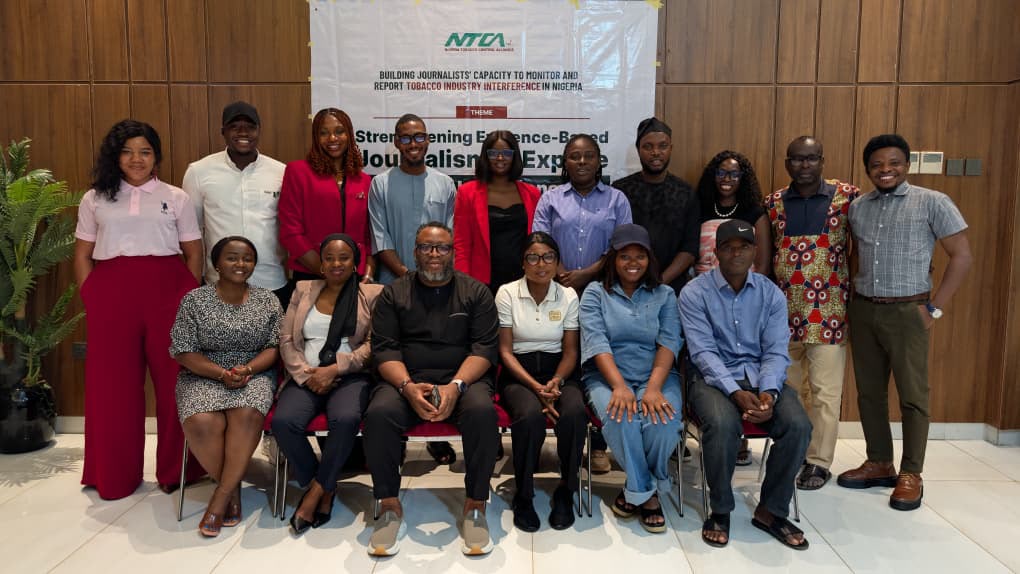
The call was made at the 2026 Media and Tobacco Control Capacity-Building Workshop, themed “Strengthening Evidence-Based Journalism to Expose Industry Interference and Advance Tobacco Control,” which was organised to equip journalists with the knowledge and skills to monitor, investigate and report tobacco industry interference.
Speaking at the workshop, the Coordinator of NTCA, Olawale Makanjuola, said journalists must rely on credible evidence, accurate information and proper context when reporting on tobacco control, given the resources and influence available to tobacco companies.
“You need to have your evidence. You need to be sure about what you’re putting out there,” he said.
Makanjuola said the workshop was not designed to teach journalists their profession but to provide them with relevant information and a deeper understanding of tobacco control issues to improve the quality of their reporting.
“We are not here to teach you your job. You guys are professionals. We are here to just share information about what our control is, what the people should actually do,” he said.
He commended journalists for their contributions to public awareness and the dissemination of information on tobacco control, noting that previous media engagements had generated interest among media organisations seeking access to the Alliance’s reports.
The NTCA coordinator also cited Nigeria’s performance in the 2026 Global Tobacco Industry Interference Index, where the country scored 62 and ranked 54th among 100 countries assessed, stressing the need for sustained monitoring, public awareness and media engagement.
He urged journalists to adopt more effective storytelling approaches when reporting technical issues to make tobacco control concerns more accessible to the public.
In a related presentation, the Media and Communication Officer of Corporate Accountability and Public Participation Africa (CAPPA), Robert Egbe, raised concerns over alleged attempts by tobacco industry players to influence Nigeria’s tobacco control policies, including a proposed plan by Philip Morris International (PMI) to introduce 20 million vapes into the country.
Egbe alleged that tobacco industry interests were influencing efforts to amend Nigeria’s tobacco control laws, warning that proposed changes could weaken existing public health protections.
He said although the National Assembly had organised a public hearing to receive stakeholders’ submissions on strengthening the National Tobacco Control Act, a different version of the proposed legislation allegedly emerged afterwards.
“We want to amend Nigeria’s Tobacco Control Act. We want to make it stronger. Everybody was happy to see, went there, and made submissions. They said, very, very strong submissions, and look, this thing must not be allowed to promote tobacco use, and everybody agreed,” Egbe said.
“We were happy, we left. Three months ago, we started hearing some funny, funny stories. They had made the bill, and they were simply trying to send it to the House of Representatives without letting us see the contents.”
He further alleged that tobacco companies were seeking to introduce new nicotine products into Nigeria without adequate consultation with relevant tobacco control stakeholders, citing PMI’s reported plan to bring in 20 million vapes and establish a factory.
Egbe said the National Tobacco Control Committee (NATOC) ought to be consulted before such decisions are taken, in line with provisions of the National Tobacco Control Act and its regulations.
“PMI, Philip Morris International, wants to bring in 20 million vapes. They want to do the factory. Should we allow them? They’re supposed to do all of that. The regulations require them, the Act requires them to do that. But they don’t want to do that. Before the Ministry of Trade will approve those things in Nigeria, or Standards Organisation of Nigeria, or whoever it is, they’re supposed to bring it to NATOC and say, NATOC, come and see us,” he said.
Referencing Article 5.3 of the World Health Organisation Framework Convention on Tobacco Control (WHO FCTC), Egbe said governments were required to protect public health policies from the commercial and other vested interests of the tobacco industry.
He said the commercial interests of tobacco companies and the government’s public health responsibilities were fundamentally incompatible.
“There is a fundamental and irreconcilable conflict between tobacco industry interest and public policy interest. They cannot merge. Their interests are totally invariant, totally,” he said.
Egbe argued that tobacco companies should not be involved in the formulation of public health policies because their commercial interests could conflict with the government’s responsibility to protect citizens.
He, however, said any necessary interaction between government institutions and tobacco companies should be transparent, open to public scrutiny and involve relevant civil society organisations.
“If for any reason there should be any interaction between both of them, it should be transparent. It should be open. It should make it known to everybody. They should even call members of civil society. They should call NTCA and other relevant stakeholders. It is important that these engagements are not conducted behind closed doors,” he said.
Egbe urged journalists to move beyond reporting isolated incidents of tobacco industry interference to investigate the policies, institutions and individuals connected to such activities.
He said reporters should establish the laws or policies allegedly breached, the government institutions responsible, the reasons the developments matter and their possible consequences for public health.
“It’s not enough to just say, XYZ, how is it connected? How is Nigeria failing? And see how that affects our tobacco industry. All of these things help us to understand, help the public to understand the issues better. So all of these help us to really situate the reports, to provide context, and to make it more impactful,” he said.
The Monitoring and Evaluation Officer of NTCA, Blessing Yashim, also raised concerns over tobacco companies’ use of corporate social responsibility (CSR) initiatives, grants, scholarships and donations to build relationships with government institutions and improve their public image.
She said such engagements could provide tobacco companies with opportunities to influence public policies and decisions intended to protect public health.
“By doing so, you open a way for them to also be involved in our policies. They will have a hand in choosing the policy that works for them. And when I remind people, they always pick the ones that fit well with them and are not fit for the public. They do not care about public health. All they care about is making money,” she said.
Yashim questioned the involvement of government institutions in memoranda of understanding (MoUs) with tobacco companies, particularly the reported partnership between British American Tobacco (BAT) and the Nigeria Customs Service.
She expressed concern that such partnerships could compromise the independence of government agencies responsible for enforcing tobacco control regulations, including efforts to combat illicit cigarette trade and strengthen track-and-trace systems.
“Do you think Customs still has that mandate to push for a track and trace, to push for stronger illicit trading law, or to push for better enforcement of those illicit trade laws? No. They’ll always do what favours them. Why? Because they shook hands,” she said.
Yashim also alleged that tobacco companies were using donations, branded materials and sponsorship activities as indirect advertising strategies despite restrictions on tobacco advertising, promotion and sponsorship.
She said organisations that accepted donations and used branded materials supplied by tobacco companies could inadvertently become channels for promoting tobacco products.
“We are only asking them. They make donations. They always have grants. We wear those donations. We wear T-shirts. We have dispatch files that we bring to people. We wear them. That’s them being an advertiser. We can’t actually be an advertiser. The currency is our activities. That’s them being an advertiser. We do the advertising, but we tell them we need it,” she said.
On enforcement, Yashim said Nigeria’s tobacco control challenge was not necessarily the absence of laws and regulations but the failure to effectively implement and enforce existing provisions.
She cited continued smoking in public places and the availability of tobacco products around secondary schools as examples of gaps between regulations and enforcement.
“We’ve already seen that we’re having issues because we have the policies. There’s somebody that said that there’s one thing when you’re an employer, you always have the law, you always have the policies. The problem is implementing the policies. We’ll be pushing for the ban on smoking in public places. All these bans and all that, they are in place. They’re still smoking,” she said.
She further alleged that some provisions and definitions appeared in the final version of the proposed tobacco control amendment bill despite not being included in the initial discussions, warning that such developments could undermine legislative transparency and public participation.
“We have seen it in our amendment bill. A bill was brought out. We said that a bill should be consolidated, but when the final bill now came, we are seeing clauses and rules that were never there in the beginning. We are seeing definitions that were never put in place. And why? Because the government will not allow you to have these conversations without them,” she said.
Concluding the workshop, the Communication Officer of NTCA, Emmanuel Onwuka, urged journalists to strengthen evidence-based reporting by supporting their stories with credible documents, data, records and first-hand observations.
He said reporters should identify what they intend to establish in their investigations and the documents, data and observations that could substantiate their findings.
“When you’re planning your story, what exactly do you want to find out? What exactly do we need to find out? Another part of the story plan is what documents, what data, what observations or records can prove that this is actually happening,” he said.
Onwuka urged journalists to complement statistics with the experiences of people affected by tobacco-related illnesses, noting that human-interest reporting could help audiences better understand the consequences of public health challenges.
“Sometimes we will say 600 people came down with tobacco-related illness. Who is this 600? Those numbers are humans. But when you begin to tell stories from a person’s perspective, you look for and identify a person that has this issue and tell the story from the person’s experience,” he said.
He, however, cautioned reporters against relying solely on emotional accounts, stressing the need to independently verify human-interest stories and support them with medical data and research.
Sharing an experience from his reporting career, Onwuka said further questioning and cross-checking with family members had helped him uncover inconsistencies in a woman’s account of losing her daughter.
“Yes, human angle stories are very, very great. But you must also do your back-end verification. You cannot misinform people. And also try to support medical data with all of those experiences. So even if someone shares a real-life story with you, try to back it up with medical data and research,” he said.
He also urged journalists to incorporate accountability into their investigations by identifying those affected, the individuals or institutions responsible, experts to be consulted and those required to explain or address the issues.
“The people, when you’re planning your story, you should look at who is affected, who is responsible, who are the experts I want to interview, and who are the people that are able to respond. Who must explain, fix, or disclose anything?” he said.
Onwuka urged journalists to treat tobacco control as an ongoing public-interest issue rather than a one-off report, encouraging them to pursue follow-up stories and maintain contact with relevant experts and sources.
“We do not want this to be a one-off story at all. We want it to be a continuous story. If you have any source in mind, you can always reach out to us and say, hey, I want to speak with a barrister, I want to speak with a doctor. We can always make those resource persons available to us,” he said.
WATCH TOP VIDEOS FROM NIGERIAN TRIBUNE TV