

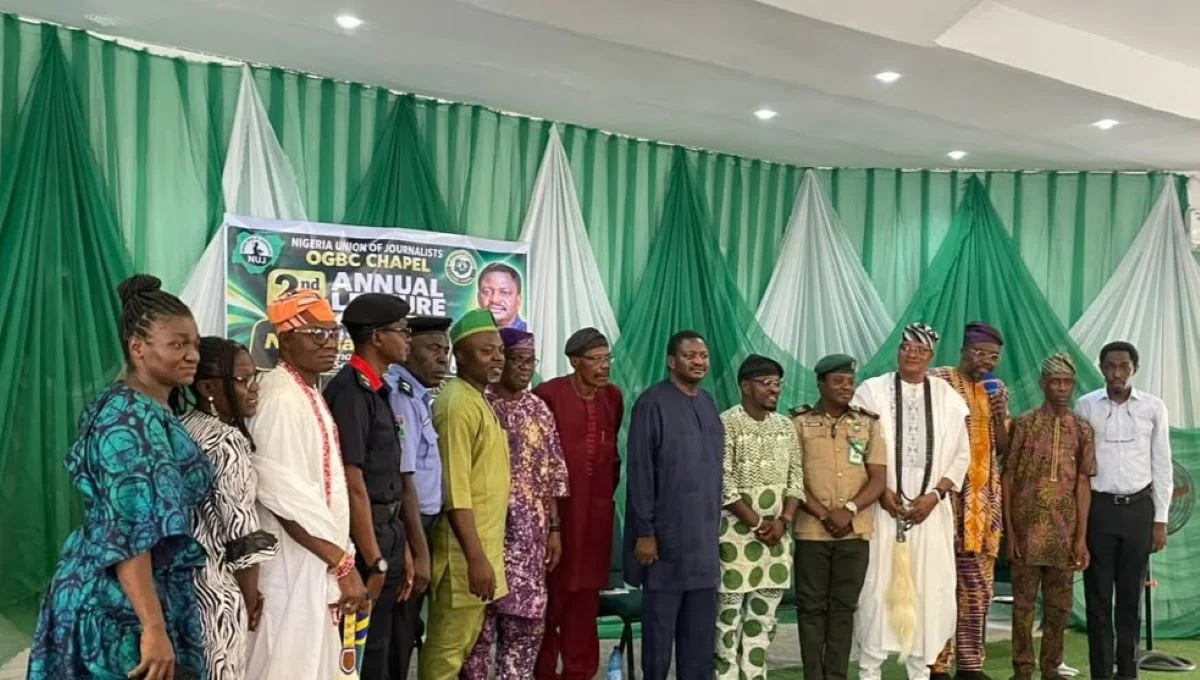
Femi Adesina urges journalists to inspire confidence in Nigeria’s future
Former presidential spokesman Mr Femi Adesina has called on Nigerian journalists to project the country in a positive light, saying the media has a critical responsibility to promote national development, strengthen national security and inspire confidence in the country’s future through balanced, truthful and responsible reportage.
He made the call on Thursday, in Abeokuta, while delivering a paper titled “Media, Conflict and National Security: The Journalist’s Role in a Changing Security Landscape” at the second annual lecture of the Nigeria Union of Journalists (NUJ), Ogun State Broadcasting Corporation (OGBC) Chapel, held at Iwe Iroyin Press Centre, Abeokuta.
He noted that the country is making significant progress despite the numerous challenges confronting it, adding that the media should help Nigerians recognise these achievements as a source of inspiration and confidence in the country’s ability to overcome its longstanding challenges.
Adesina urged journalists to move beyond the perception that only negative stories attract public attention, stressing that the media should give adequate attention to the positive developments and achievements recorded in the country without compromising its watchdog responsibility.
The media icon also acknowledged that the country was grappling with several security, economic, and social challenges and argued that responsible journalism required acknowledging both the good and the bad, rather than allowing negative narratives to dominate public discourse.
ALSO READ: Tinubu honours Wole Olanipekun with GCON
“Reality is about acknowledging the good while also not ignoring the bad. Reality is about finding the right balance, and I would in fact like to argue that this should be done with a bias towards the positive.
“Nigeria has many challenges, many of which we have been dealing with for a long time, but we are also making progress in very important ways, and we must inspire ourselves with this progress as a way of convincing ourselves that even our most protracted challenges are not insurmountable.
“The media must resist the pervading belief that only bad news sells. Why is it that the activities of Boko Haram are usually amplified in the media, while no one gets to hear about the more frequent heroism of the gallant officers and men of the Nigerian Armed Forces?” he said.
The former presidential spokesman cautioned media organisations against giving undue prominence to individuals and groups promoting ethnic and religious hatred, violence and division, while voices advocating peace, unity and national progress were ignored or downplayed.
He also expressed concern over the tendency to amplify the activities of terrorists and criminal elements at the expense of the sacrifices and heroism of personnel of the Nigerian Armed Forces and other security agencies.
Adesina, who cited the 1994 Rwandan genocide as an example of the destructive power of irresponsible broadcasting, warned that media platforms could become instruments of violence when manipulated through hate speech, incitement and misinformation.
He recalled how two Rwandan radio stations, Radio Rwanda and Radio Télévision des Mille Collines (RTLM), contributed to the atmosphere of hatred and violence that culminated in the genocide in which close to one million people were killed.
He, however, noted that the media could also serve as a powerful instrument for peace, national cohesion and democratic development, citing the contributions of Radio Kudirat to Nigeria’s pro-democracy struggle as an example of the positive use of mass communication.
In his remarks, the State Chairman of the NUJ, Comrade Wale Olanrewaju, reiterated the need for journalists to uphold professionalism, accuracy and ethical standards in reporting security-related issues to avoid escalating tensions and threatening national peace.
Olanrewaju, represented by the Secretary of the Council, Comrade Bunmi Adigun, noted that while journalists must balance the public’s right to know with national security concerns, this should not undermine press freedom, stressing that what the country needs is responsible journalism, not intimidated journalism.
He also called for continuous training, journalist safety and stronger collaboration between media organisations and security agencies.
Olanrewaju commended the OGBC Chapel for sustaining the annual lecture, describing it as a platform for intellectual engagement and professional development. He urged the chapel to sustain the initiative, inspire younger journalists, and strengthen ethical standards in the profession.
WATCH TOP VIDEOS FROM NIGERIAN TRIBUNE TV