
African Speakers Move to Break Trade Barriers, Harmonise Laws at Liberia Summit – THISDAYLIVE
Follow THISDAYLIVE on GoogleAdd us as a preferred source to see more of our stories in Google
Michael Olugbode in Abuja
African parliamentary leaders are set to push for the harmonisation of national laws, removal of trade barriers and expansion of cross-border infrastructure when they converge on Monrovia, Liberia, for the fourth General Assembly of the Conference of Speakers and Presidents of African Legislatures (CoSPAL) from December 9 to 11, 2026.
The summit is expected to intensify pressure on African governments to translate their commitments to continental economic integration into enforceable national laws, amid concerns that conflicting regulations, non-tariff barriers and inadequate infrastructure continue to undermine the ambition of the African Continental Free Trade Area (AfCFTA).
Chairman of CoSPAL and Speaker of Ghana’s Parliament, Alban Bagbin, said Africa’s economic integration remained constrained by decades of political and economic fragmentation, which had left countries operating under different legal frameworks that obstruct trade, investment and the movement of people across borders.
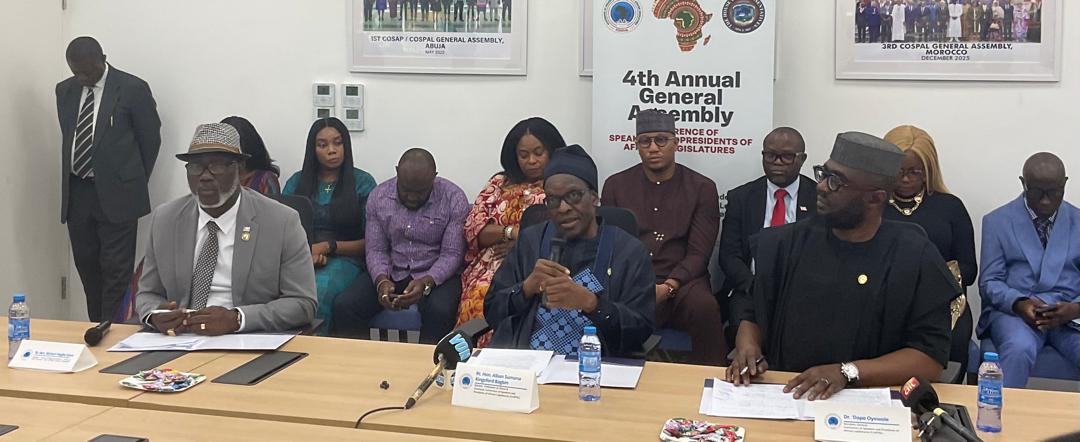
Speaking at a media briefing at the CoSPAL Secretariat in Abuja, Bagbin argued that the continent could not achieve a functional single market while national laws continued to create obstacles to the movement of goods, services and capital.
He said the AfCFTA required more than political commitments and executive declarations, stressing that national parliaments must take the lead in harmonising legislation, removing conflicting regulations and establishing common standards to facilitate continental trade.
“The African Continental Free Trade Area cannot be delivered by executive declarations alone,” Bagbin said, advocating the adoption of shared model laws by African legislatures to eliminate legal inconsistencies and ease cross-border economic activities.
The AfCFTA, which became operational in 2021, is designed to progressively remove tariffs on most goods traded among participating African countries, reduce non-tariff barriers and create a continental market capable of stimulating investment, industrialisation and regional value chains. However, differences in national regulations, customs procedures and trade standards remain major obstacles to its full implementation.
Bagbin said African parliaments must therefore move beyond their traditional domestic lawmaking responsibilities and become active participants in the continent’s integration process.
He also identified infrastructure connectivity as critical to the success of the single market, warning that trade integration would remain difficult without reliable regional energy, transport and other cross-border networks.
Citing the West African Gas Pipeline and proposed gas and solar energy networks, he said such projects required coordinated legislative action among participating countries.
According to him, parliaments must enact the necessary enabling laws, scrutinise public expenditure and ensure that investments in regional infrastructure are properly implemented and deliver tangible benefits.
Bagbin also highlighted CoSPAL’s role in parliamentary diplomacy, citing its intervention in Liberia during a legislative leadership impasse involving political parties and former Presidents Ellen Johnson Sirleaf and George Weah.
He said the organisation’s mediation demonstrated how parliamentary engagement could help resolve political disagreements and strengthen democratic institutions. He also disclosed that CoSPAL was engaging on issues concerning parliamentary participation in Uganda.
Secretary-General of CoSPAL, Ambassador ‘Dapo Oyewole, said the Monrovia assembly would address issues beyond trade and investment, including security, transportation, aviation and connectivity, as part of efforts to strengthen Africa’s economic capacity and protect its sovereignty.
He said the continent must build stronger regional partnerships and develop the capacity to harness its own resources and markets rather than remain constrained by fragmented economies and dependence on external actors.
Oyewole disclosed that the assembly would produce the Monrovia Declaration, following previous declarations adopted at CoSPAL assemblies in Abuja, Rabat and Accra.
He said the declaration would set out further commitments towards strengthening legislative leadership and advancing Africa’s political, economic and institutional integration.
The Secretary-General also underscored the importance of parliamentary diplomacy in resolving disputes between African countries, recalling the 2020 trade disagreement between Nigeria and Ghana.
He said a three-day parliamentary mission to Accra, led by Femi Gbajabiamila, then Speaker of Nigeria’s House of Representatives, helped resolve the dispute after efforts at the executive level had stalled.
Oyewole said the intervention demonstrated the capacity of parliamentary leaders to provide alternative channels of dialogue and confidence-building when disagreements threaten trade and bilateral relations.
On CoSPAL’s institutional development, he said the organisation was implementing programmes to strengthen women’s representation, legislative capacity and leadership development across African parliaments.
He listed the Women’s Representation in African Parliaments (WRAP) initiative and the African Gender Legislative Agenda among its programmes aimed at promoting greater participation of women in legislative institutions.
Oyewole said the Legislative Mentorship Initiative, founded by Gbajabiamila, had evolved into a continental programme, with 50 fellows expected to graduate on Friday, bringing the total number of alumni to 268.
He said the programme was designed to develop a new generation of legislative professionals and leaders equipped to contribute to effective lawmaking, parliamentary administration and democratic governance.
The Secretariat, he added, had established a legislative research and knowledge management network to promote the exchange of expertise and strengthen evidence-based lawmaking among African parliaments.
He further disclosed that CoSPAL had begun work on artificial intelligence governance in legislatures, an emerging area with implications for parliamentary administration, legislative research, accountability and the regulation of new technologies.
Speaker of Liberia’s House of Representatives and host Speaker of the fourth CoSPAL General Assembly, Rt. Hon. Richard Nagbe Koon, said hosting the meeting would provide an opportunity for Liberia to showcase its investment potential, hospitality and commitment to continental cooperation.
Koon said Liberia wanted African countries to regard one another as strategic partners in trade, investment, innovation and development, rather than merely as neighbouring states.
He said the gathering would provide a platform for strengthening relationships among African legislatures and creating opportunities for wider economic and institutional cooperation.
CoSPAL was founded by the Speakers of the parliaments of Nigeria, Senegal, Ethiopia, Kenya and Rwanda to provide a common platform for legislative leaders to exchange experiences, coordinate action and strengthen the contribution of parliaments to Africa’s development.
Its emergence reflects growing recognition that continental integration cannot be driven by the executive arm of government alone. National legislatures are central to translating regional agreements into domestic laws, providing oversight, monitoring implementation and holding governments accountable for their commitments.
The Monrovia assembly will therefore be an important test of the willingness of African parliamentary leaders to turn years of integration pledges into practical legislative action. Its success will ultimately depend not only on the declaration adopted at the meeting but on whether participating parliaments can drive reforms that make cross-border trade easier, strengthen infrastructure connectivity and deepen cooperation among African countries.