

Nigeria’s tier-one banks report N2.91trn profit on fee income, lower credit losses
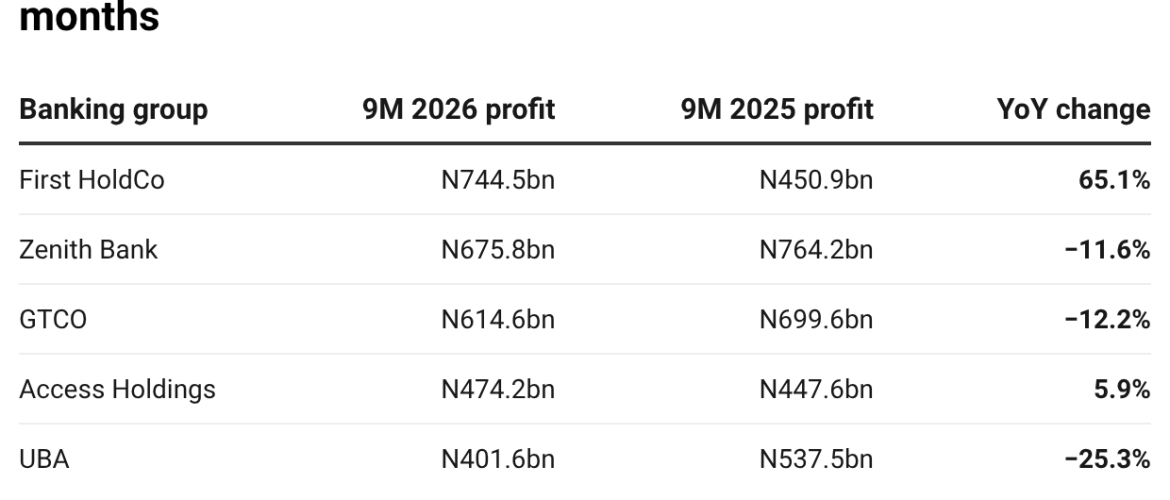
Nigeria’s tier-one banking groups generated a combined N2.91 trillion in profit after tax in the first nine months of 2026, driven by lower credit impairment charges and stronger transaction-based income.
An analysis of the nine-month financial results of First HoldCo, Zenith Bank, Guaranty Trust Holding Company (GTCO), Access Holdings, and United Bank for Africa (UBA) shows that their combined profit increased marginally by 0.4 percent from N2.90 trillion recorded in the corresponding period of 2025.
FirstHoldCo recorded the highest profit after tax of N744.45 billion, followed by Zenith Bank with N675.83 billion, GTCO with N614.57 billion, Access Holdings with N474.17 billion, and UBA with N401.60 billion.
First HoldCo, Access lead earnings recovery through lower credit costs
The strongest contribution to profit growth came from First HoldCo, whose profit after tax increased 65.1 percent to N744.45 billion from N450.87 billion.
The improvement was largely driven by a 143.5 percent increase in non-interest income to N722.9 billion, alongside a 28.3 percent decline in impairment charges to N207.1 billion.
Net fee and commission income increased 48.1 percent to N316.43 billion, while gains from financial instruments measured at fair value through profit or loss rose to N104.59 billion from a loss of N72.78 billion in the corresponding period of 2025.
These gains helped offset a 16 percent decline in net interest income to N1.26 trillion, reflecting the pressure on traditional lending earnings.
The group also reduced operating expenses by 8.1 percent to N866.6 billion, helping lift profit before tax by 60.8 percent to N911.24 billion.
Wale Oyedeji, group managing director of First HoldCo, said the performance demonstrated the strength of its diversified financial services platform.
“This performance was supported by a 143.5% increase in non-interest income to N722.9 billion, partly driven by a 48.1% rise in net fee and commission income to N316.4 billion, which underscores the growing contribution of transaction-led revenues,” he said.
He added that disciplined execution strengthened operating efficiency, asset quality, and capital, with the group’s cost-to-income ratio improving to 43.7 percent from 52.4 percent.
Access Holdings also recorded improved earnings quality, with profit after tax rising 5.9 percent to N474.17 billion from N447.55 billion.
The key driver was a 73.5 percent reduction in impairment charges to N92.91 billion from N349.99 billion. This helped increase net interest income after impairment by 32.1 percent to N1.20 trillion.
The group’s net fee and commission income also rose 12.4 percent to N534.94 billion, while core operating income increased 5.4 percent to N1.83 trillion.
However, operating expenses increased 11.8 percent to N1.30 trillion, while total operating income declined 3.2 percent to N2.06 trillion, limiting the improvement in profitability.
Innocent C. Ike, group managing director and chief executive officer of Access Holdings, said the significant reduction in impairment charges, alongside growth in net interest income after impairment and net fee and commission income, demonstrated the resilience of the group’s core earnings base.
He said the group’s Scale-to-Value agenda would focus on stronger execution capacity, risk governance, disciplined capital allocation, operating efficiency, and improved capital productivity.
Zenith, GTCO face pressure from weaker trading earnings
While lower credit costs supported earnings at First HoldCo and Access Holdings, Zenith Bank and GTCO recorded declines in profit after tax, highlighting the impact of weaker non-interest income and rising operating expenses.
Zenith Bank’s profit after tax declined 11.6 percent to N675.83 billion from N764.20 billion, despite a substantial reduction in impairment charges.
The bank reduced impairment charges by about 70.5 percent to N230.77 billion from N782.76 billion, helping lift net interest income after impairment to N1.70 trillion from N1.14 trillion.
Interest income remained relatively stable at N2.62 trillion, while interest expenses declined 15.4 percent to N688.73 billion, leaving net interest income slightly higher at N1.93 trillion.
However, trading income swung from a gain of N277.65 billion in the first nine months of 2025 to a loss of N229.19 billion in 2026.
The resulting deterioration in trading performance, alongside an 18.4 percent increase in operating expenses to N1.02 trillion, weighed on earnings.
Adaora Umeoji, group managing director and chief executive officer of Zenith Bank, said growth in lending, transaction volumes, and customer deposits continued to support the business.
“Our performance during the first nine months of 2026 reflects the increasing contribution of customer-driven business activities across the Group. Growth in lending, transaction volumes and customer deposits continued to support the business during the period, while lower funding and credit costs contributed to profitability and improved earnings quality,” she said.
GTCO also recorded a 12.2 percent decline in profit after tax to N614.57 billion from N699.64 billion.
Its profit before tax declined 2.3 percent to N879.90 billion, while net interest income fell 1.7 percent to N935.88 billion.
However, the group benefited from lower loan impairment charges, which declined 58.4 percent to N29.02 billion from N69.79 billion.
Net interest income after impairment increased to N906.86 billion from N882.35 billion, while net fee and commission income rose 4.5 percent to N182.42 billion.
The pressure came from higher interest expenses, which increased 27.7 percent to N356 billion, alongside higher depreciation and other operating expenses.
Tax expense also increased 31.9 percent to N265.32 billion from N201.16 billion, contributing to the larger decline in profit after tax relative to pre-tax earnings.
Segun Agbaje, group chief executive officer of GTCO, said the group’s core earnings continued to grow despite significant fair value losses.
“Despite a challenging operating environment and significant fair value losses in the period, our core earnings continued to grow, our deposit base expanded strongly, our cost efficiency remains among the best in the industry, and our balance sheet remains strong, liquid, and well capitalised,” he said.
UBA’s rising credit losses expose earnings vulnerability
UBA recorded the sharpest profit decline among the five banking groups, with profit after tax falling 25.3 percent to N401.60 billion from N537.53 billion.
The decline was largely driven by a sharp increase in impairment charges on loans, which rose to N255.09 billion from N46.11 billion.
Including impairment charges on other financial assets, total impairment costs increased to N272.12 billion from N56.89 billion, significantly eroding the group’s operating income.
The increase in credit costs occurred despite improvements in other income lines.
UBA’s net interest income increased 2.7 percent to N1.19 trillion, while non-interest income surged 48.8 percent to N477.25 billion, supported by growth in trading and foreign exchange income.
Net fee and commission income also increased 10.2 percent to N270.73 billion.
However, the improvement in these revenue lines was insufficient to offset the increase in impairment charges and operating expenses, which rose 5.7 percent to N894.33 billion.
Consequently, profit before tax declined 13.1 percent to N502.98 billion, while higher taxation further weakened its bottom-line performance.
Market reaction
The Nigerian Exchange Banking Index closed Friday at 2,299.75 points, shedding 45.31 points or 1.93 percent during the trading session, although it remained up 68.02 percent over the past year.
According to BusinessDay analysis, the share prices of Nigeria’s tier-one banks have come under pressure since announcing their nine-month financial statements, suggesting a cautious investor response despite their earnings performances.
First HoldCo, which released its results on October 23, recorded the steepest decline, with its share price falling 27 percent from N144.10 on the announcement date to N105.20 as of the close of trading on Friday, November 20.
Zenith Bank, which announced its results on October 9, saw its share price decline by 17.97 percent from N134.70 to N110.50 over the same period.
GTCO, whose nine-month financial results were released on October 27, recorded a 7.47 percent decline in its share price, falling from N123.20 on the announcement date to N114 as of November 20.
Access Holdings recorded a relatively marginal decline of 0.75 percent, with its share price slipping from N26.50 on November 2, when it announced its results, to N26.30 at Friday’s close.
UBA, which released its nine-month results on November 20, maintained its share price at N38.25, unchanged from its closing price on the announcement date.

Chinwe Michael is a Nigerian business journalist and media professional with over 4 years of experience covering companies, financial markets, banking, fintech, economic policy, financial inclusion, and corporate affairs. She currently leads the Companies & Markets desk at BusinessDay, where she drives coverage of Nigeria’s corporate and capital markets, translates complex financial data into accessible stories, and mentors younger journalists. Prior to that, she was the head of the financial inclusion/fintech desk. With a background in banking and finance and extensive experience in media and communications, Michael has developed expertise in financial journalism, economic analysis, investigative reporting and market intelligence. Her work examines how monetary policy, corporate performance, capital flows, technology, and regulatory decisions affect businesses, investors, and households. She was selected from about 3,000 applicants as one of 20 journalists for Cohort 4 of the MTN Media Innovation Programme, gaining exposure to new approaches to journalism, technology, and media innovation. Her international journalism experience and engagement with professionals across Russia, Dubai, Saudi Arabia, and others in different sectors have further broadened her understanding of global communication and development.


