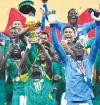
Explainer: Why CAS Reinstated Senegal As The Rightful 2025 AFCON Champions

The Court of Arbitration for Sport (CAS) reinstated Senegal as the 2025 Africa Cup of Nations winners on 24 November 2026, overturning a Confederation of African Football (CAF) ruling that had stripped the title and awarded it to Morocco.
The decision hinged on a single, decisive legal question: once a referee restarts a match, can a later disciplinary body retroactively declare it forfeited? CAS answered no, restoring Senegal’s 1-0 final victory.
The Dispute in Brief
Senegal beat hosts Morocco 1-0 after extra time in Rabat on 18 January 2026. The match was interrupted for roughly 15 minutes in stoppage time when Senegalese players left the pitch to protest a penalty awarded to Morocco. The referee, Jean-Jacques Ndala, eventually restarted play; Morocco missed the penalty, and Senegal won in extra time.
On 17 March 2026, CAF’s Appeal Board ruled that Senegal had forfeited the match by leaving the field, invoking Articles 82 and 84 of the AFCON Regulations. It recorded the result as a 3-0 win for Morocco. Senegal appealed to CAS on 25 March; a three-member panel heard the case in Lausanne on 8 October.
The Core Legal Battleground: Two Competing Arguments
The case turned on the tension between two sets of rules:
1. Morocco’s argument: strict application of Articles 82 and 84
Morocco’s federation (FRMF) argued that Senegal’s temporary walk-off automatically triggered a forfeit under the tournament regulations. Article 82 states that a team which “leaves the ground before the regular end of the match without the authorisation of the referee… shall be considered loser and shall be eliminated”.
Article 84 prescribes the 3-0 forfeit scoreline. On this reading, the referee’s later decision to resume was irrelevant; the breach had already occurred.
2. Senegal’s argument: the referee’s decision is final under the “Field of Play” doctrine
Senegal argued that the referee’s decision to resume the match at the 109th minute (90+19) was a purely on-field judgment that cannot be second-guessed by a disciplinary panel.
Under the “Field of Play” doctrine—a cornerstone of sports law derived from football’s Laws of the Game—a referee’s decisions on matters of fact connected to play (including whether to stop, suspend, or restart a match) are final and not subject to retrospective legal review.
The referee had determined that the conditions for resuming were met: both teams were back on the pitch and willing to continue.
How CAS Resolved It
CAS sided with Senegal, but its reasoning was precise and narrow. The panel did not say Senegal’s walk-off was acceptable; it said the forfeiture provisions were simply inapplicable to what actually happened.
The key finding was that Articles 82 and 84 are triggered only when a team’s conduct leads the referee to permanently abandon the match. As CAS put it: the provisions are “intended solely to determine the outcome of a match when a team’s conduct leads the referee to call off the game permanently”.
In Rabat, the referee did not permanently abandon the match—he restarted it. Because the match was played to a conclusion, the forfeiture machinery never engaged.
The panel further held that the referee’s decision to restart was within his “sole authority” and was covered by the Field of Play doctrine. It rejected Morocco’s claim that the referee had committed a legal error or acted arbitrarily, noting that he made the call in an “atmosphere of extreme tension” but that this did not taint the decision. CAS Secretary General Matthieu Reeb summarised the outcome bluntly: “The CAS panel finds that the referee did not commit any error of law”.
Crucially, CAS distinguished the match result from disciplinary sanctions. It noted that Senegal’s federation, coach, and certain players had already faced separate disciplinary proceedings—and those sanctions were unaffected. The CAS ruling was about who won the match, not about excusing the walk-off.
What This Means
The reinstatement is a victory for the finality of refereeing decisions in football. It establishes that a disciplinary body cannot use a forfeiture rule to retroactively rewrite a result that the referee, exercising his on-field authority, chose to complete.
Morocco Rejects CAS Verdict, Vows Legal Battle Over Senegal’s AFCON Title
Senegal remain 2025 AFCON champions; Morocco’s only remaining legal avenue would be Switzerland’s Federal Court, and only on narrow procedural grounds, not on the substance of the case.
We’ve got the edge. Get real-time reports, breaking scoops, and exclusive angles delivered straight to your phone. Don’t settle for stale news. Join LEADERSHIP NEWS on WhatsApp for 24/7 updates →