Power minister inaugurates 3MW solar hybrid project at Michael Okpara University
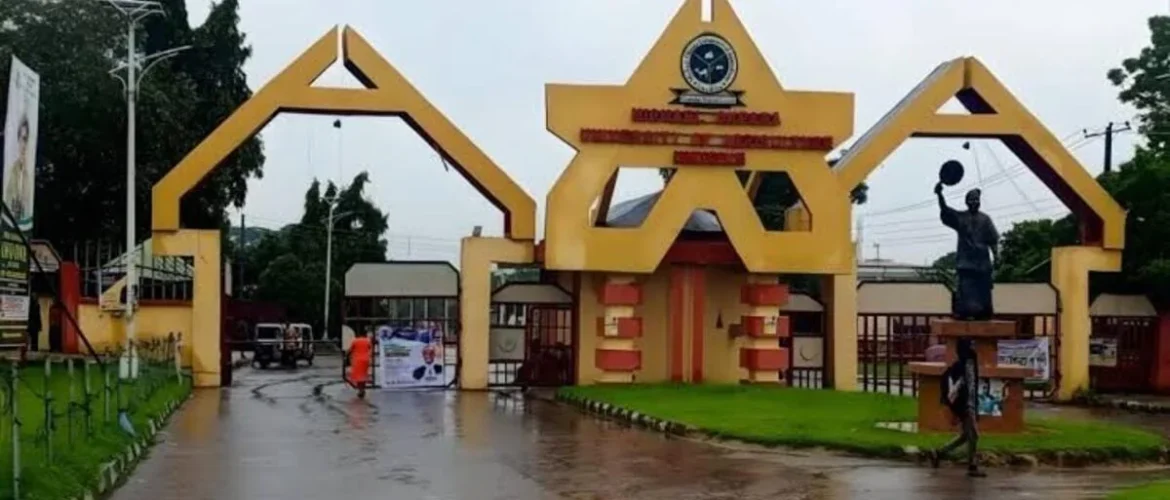
The Minister of Power, Joseph Tegbe, has officially inaugurated a 3.0MW solar hybrid project at Michael Okpara University of Agriculture, Umudike, Abia State.
The project was launched under Phase II of the Energising Education Programme (EEP), funded by the World Bank and implemented by the Rural Electrification Agency (REA). It is designed to benefit seven Nigerian universities and two teaching hospitals across the six geopolitical zones.
In his keynote address, Minister Tegbe emphasised President Bola Ahmed Tinubu’s administration’s commitment to transforming electricity from a longstanding barrier to economic growth into a reliable enabler of national prosperity.
He highlighted the importance President Tinubu attaches to education and his determination to ensure that every young Nigerian has the opportunity to learn with dignity and reach their potential.
The Minister further explained that the Federal Government’s approach combines improved grid infrastructure with renewable and distributed energy systems tailored to the specific needs of various communities and institutions.
“Universities, healthcare facilities and productive centres require solutions that cater to their actual needs,” he stated.
The Abia State Governor, represented by the Commissioner for Power, Hon. Ikechukwu Monday, praised the EEP for its excellent conception and continued relevance. He expressed gratitude to the Federal Government for its commitment to electrification across Abia State and beyond.
“The project will benefit lecturers, students and anyone involved in scientific research,” he noted.
The Governor commended the Federal Government for its commitment to implementing the institution’s energy strategy, supporting the nation’s efforts to address the longstanding challenge of energy adequacy.
Additionally, the Managing Director of the REA, Dr Abba Aliyu, said: “Today, we are inaugurating a 3MW solar hybrid power plant, complemented by 2.2MWh of battery energy storage, rehabilitated distribution infrastructure, streetlights and a renewable energy training centre. However, beyond these impressive engineering achievements, we are commissioning an infrastructure of possibilities—the potential for uninterrupted research, advanced agricultural innovation, extended learning hours and the emergence of a new generation of entrepreneurs.
“Globally, the countries that excel in agricultural production are not necessarily those with the most extensive farmland; they are the ones that have effectively integrated agriculture with energy, technology, research and innovation. Nigeria must intentionally pursue this pathway. Under President Bola Ahmed Tinubu’s leadership and the strategic guidance of the Honourable Minister of Power, we are witnessing a fundamental transformation in the scale, ambition and economic impact of decentralised electrification in Nigeria.
“Through the Energising Education Programme alone, we have established energy infrastructure across 22 federal universities and three affiliated teaching hospitals, with over 100MW of installed capacity, positively impacting more than 600,000 students and 50,000 faculty and staff. Under Phase II of the programme, supported by the World Bank, we have also provided hands-on renewable energy training to 140 female students in science, technology, engineering and mathematics.
“Nonetheless, what we are doing here today is only one component of a much larger national transformation. Through the completed Nigeria Electrification Project, we delivered 198 mini-grids and facilitated the deployment of approximately 1.4 million solar home systems across Nigeria. Building on that success, we are implementing the $750 million World Bank-supported Distributed Access through Renewable Energy Scale-up programme (DARES), which aims to provide electricity access to 17.5 million Nigerians, including plans for approximately 1,350 mini-grids.
“Our ambition is not just to be consumers but to position Nigeria as a manufacturer and exporter of solar technology. I envision a future where some of the renewable energy technology used in this project is produced in Abia State. A university powered by reliable energy must not only produce graduates but also innovative solutions,” he added.
In her welcome remarks, the Vice-Chancellor of the university, Prof. Ursula Ngozi Akanwa, thanked the Federal Government for its intervention, stating that reliable electricity was essential for the university to fulfil its mandate effectively. She said the institution’s mandate focuses on agricultural development, scientific research, innovation and delivering practical solutions to national challenges.
WATCH TOP VIDEOS FROM NIGERIAN TRIBUNE TV