Delta Assembly passes N1.272 trillion budget for 2027, raises capital spending to N842 billion
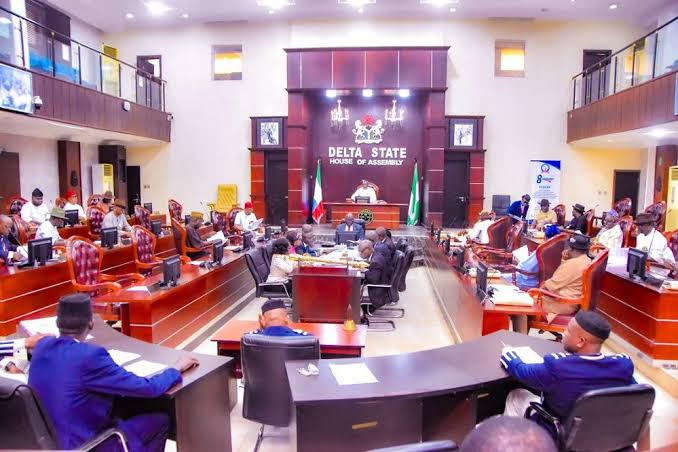
The Delta State House of Assembly has passed a N1.272 trillion budget for the 2027 fiscal year, increasing capital expenditure by N35.2 billion to N842 billion.
The development was reported by the News Agency of Nigeria (NAN) on Wednesday.
The approved budget is higher than the N1.23 trillion proposal presented by Governor Sheriff Oborevwori on November 16, with recurrent expenditure retained at N430 billion and additional funding directed towards priority capital projects.
Delta Assembly approves N1.272 trillion 2027 budget
Presenting the report of the House Committee on Finance and Appropriation, its Chairman, Mrs Marilyn Okowa-Daramola, representing Ika North-East, said the committee retained the proposed N430 billion for recurrent expenditure but increased capital spending from N806.8 billion to N842 billion.
She said the additional N35.2 billion was intended to accommodate priority projects aimed at accelerating infrastructure development and improving residents’ living conditions. According to her, the adjustment would strengthen infrastructure delivery, stimulate economic activities and promote inclusive development across the state.
- “The Delta House of Assembly on Wednesday passed the state’s N1.272 trillion Appropriation Bill for the 2027 fiscal year.
- “The bill was passed through a voice vote at a plenary presided over by the Speaker, Mr Dennis Guwor, in Asaba,” the NAN report read in part.
Okowa-Daramola also said the fiscal framework aligned with the administration’s priorities in education, agriculture, healthcare, industrialisation and youth empowerment.
She added that the budget placed emphasis on agricultural production and processing, food security, access to quality healthcare and skills development for young people.
Delta Assembly forwards budget to governor
The Majority Leader of the Assembly, Dr Emeka Nwaobi, representing Aniocha North, moved the motion for the adoption of the bill, which was seconded by Mr Festus Okoh, representing Ika South.
Nwaobi also moved the motion for the third reading, seconded by Mr Perkins Umukoro, representing Sapele, before lawmakers passed the bill through a voice vote.
Following its passage, the Speaker, Mr Dennis Guwor, directed that a clean copy of the bill be forwarded to Governor Oborevwori for assent.
Guwor commended the governor for his commitment to the development of the state and praised the House Committee on Finance and Appropriation and other lawmakers for their contributions to the passage of the budget.
The bill is awaiting the governor’s assent before it can become law.
How other states are preparing 2027 budgets
Delta is among several Nigerian states that have begun the legislative process for their 2027 budgets, although they are at different stages of approval.
- Katsina State has completed the process, with Governor Dikko Radda signing its N828.58 billion 2027 Appropriation Bill into law on October 1, 2026. The budget provides N637.85 billion for capital expenditure and N190.73 billion for recurrent spending.
- In Abia State, Governor Alex Otti presented a proposed N1.2 trillion budget to the House of Assembly on November 19, with N960 billion, representing 80% of the total, earmarked for capital expenditure. The remaining N240 billion was allocated to recurrent spending.
- Similarly, Akwa Ibom State’s Executive Council approved a proposed N1.2 trillion budget on November 13, comprising N768.7 billion for capital expenditure and N431.3 billion for recurrent expenditure. The draft bill was subsequently sent to the State House of Assembly for consideration.
- Osun State also approved its 2027 draft budget through the State Executive Council on November 19 and directed that it be transmitted to the House of Assembly.
- Meanwhile, Anambra State Governor Chukwuma Soludo presented a proposed N893.44 billion budget to the House of Assembly on November 24, representing a 16.58% increase over the 2026 fiscal estimate.
Yobe State Governor Mai Mala Buni also presented a proposed N532.27 billion budget on November 24, with N288.43 billion allocated to recurrent expenditure and N243.85 billion to capital projects.