Nigeria strengthens public sector data governance with Meta partnership
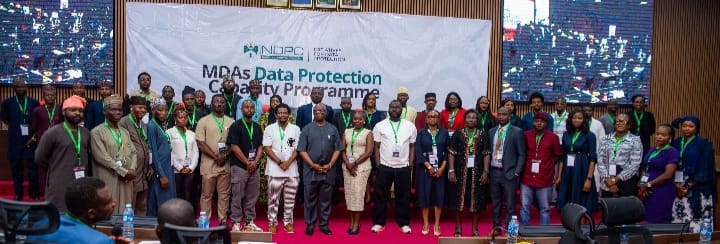
The Nigeria Data Protection Commission (NDPC) and Meta have concluded a three-day data protection training programme for about 380 public officers in Abuja.
Held from October 27 to 29 2026 under the commission’s Initiatives for Data Protection, the joint programme drew participants from several ministries, departments and agencies (MDAs). Representatives attended from the Economic and Financial Crimes Commission (EFCC), the Independent National Electoral Commission (INEC) and the Corporate Affairs Commission (CAC). The sessions aimed to strengthen the secure, lawful and transparent handling of personal data across Nigeria’s public institutions.
Declaring the training open, Vincent Olatunji, the NDPC’s national commissioner and chief executive, said the public sector was the largest processor of personal data in every country.
He said effective compliance relied on sound systems, structured processes and continuous staff development. “The weakest link in the organisation can be anybody, and that is why capacity building and awareness is very, very key to us — to ensure that everybody is carried along,” he said.
Olatunji also pointed to the need for external partnerships to fulfil the regulator’s remit. “The commission’s mandate is not something that we can achieve alone. That is why partnership is really key to us,” he said, urging attendees to foster a culture of privacy within their respective agencies.
Effective governance of citizen data requires both regulatory leadership and broad operational awareness. To meet these needs, organisers divided the workshop into two tracks: an intensive technical course for designated data protection officers (DPOs) and a foundational course for general administrative staff and public servants.
The programme began on October 27 with the foundational track for administrative personnel who handle personal data daily. Sessions covered core compliance rules, citizen data rights and practical risk prevention. Participants who completed this stage received an entry-level data protection certificate.
On October 28 and 29, the focus shifted to the technical track for designated DPOs across various MDAs. This stream addressed day-to-day compliance duties and legal obligations for managing government data infrastructure. Modules included building internal compliance frameworks, maintaining records of processing activities (RoPA), establishing lawful bases for public data processing and securing inter-agency data transfers. Attendees also reviewed breach detection, incident management and regulatory protocols for engaging with the NDPC.
Private sector specialists, including Meta’s data protection officer for Africa, the Middle East and Turkey (AMET), shared practical advice on managing compliance in large organisations. Upon completion, participating DPOs received official certification alongside NDPC continuing professional development (CPD) points.
In total, the programme trained about 380 public officers across both streams, including 80 DPOs. Post-training evaluations showed strong knowledge gains among the 300 general administrative staff, with 92% rating their understanding of data protection as significant or extensive after the course.
The technical DPO workshop recorded similar results. About 94% of participants rated their grasp of key topics, such as data protection impact assessments (DPIA) and RoPA, as significant or extensive by the end of the sessions.
Overall satisfaction averaged 4.4 out of 5 for the technical track and 4.5 out of 5 for the general track. Following positive feedback from attendees, the NDPC plans to hold further sessions across both tracks to build additional capacity within the public sector.

Athekame Kenneth is a politics, economy, and finance reporter whose work is anchored in sharp investigative storytelling. He brings analytical depth to every piece, drawing on a strong academic foundation that includes a degree in Economics, an MBA in International Trade, and a minor in Petroleum Economics from Lagos State University, Ojo. His reporting blends rigorous research with a keen eye for hidden truths, delivering stories that illuminate power, policy, and the forces shaping everyday lives.