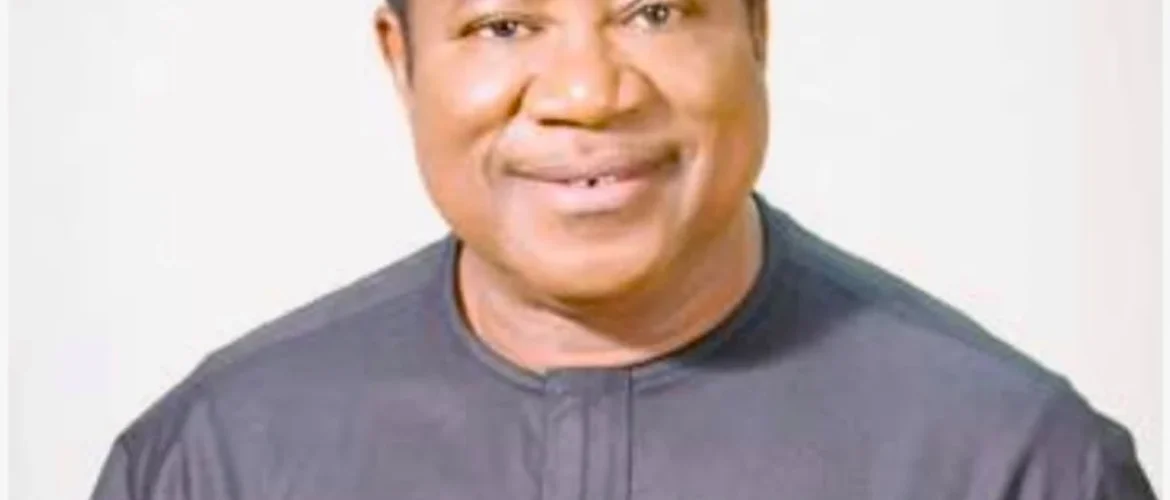
Politics is not dirty — Pastor Femi Emmanuel
Says church leaders must change their teachings
In this excerpt monitored by SEYI SOKOYA on Channels Television’s Inside Sources, Pastor Femi Emmanuel, founder of Living Spring Chapel International and National Director of Politics and Governance of the Pentecostal Fellowship of Nigeria (PFN), speaks on the church’s role in nation-building, Christian participation in politics and Nigeria’s political challenges.
You have consistently advocated greater Christian participation in politics and governance. Why do you think this has become necessary?
I believe the church must wake up to its responsibility in the affairs of this country. My concern is that we have a large Christian population, enormous human resources and the capacity to influence the direction of Nigeria, yet we have largely surrendered the political space to people who do not necessarily share our aspirations for the country.
The problem is that we have not understood where political power really lies. Many Christians believe that once they have their Permanent Voter Cards (PVCs), they have fulfilled their political responsibility. No! Obtaining a voter’s card is only one aspect of political participation. You must be involved in the political parties, attend ward meetings and participate in the process through which candidates emerge.
If you wait until election day before becoming interested in politics, you may discover that the people you are expected to vote for have already been selected by a structure you never participated in.
Are you saying the church has contributed to the political situation in Nigeria?
Absolutely. The church community is an imprisoned community. We, the general overseers, and I am not excluding myself, have imprisoned our members through our doctrines and teachings.
We have told them that politics is evil, politics is dirty and that they should leave politics for politicians. That is what has brought us to where we are today.
How can you continually complain about bad governance when you have deliberately kept your members away from the process of producing those who govern them?
I challenge pastors, particularly those with large congregations, to conduct a simple assessment next Sunday. Ask your members how many of them have voters’ cards. You will see many hands raised, perhaps half of the congregation. Then ask how many have party membership cards and regularly participate in ward meetings. You may not see one hand.
That is the contradiction we must address.
We cannot continue to complain about the political class when we refuse to become part of the political process.
Some Christian leaders argue that politics is dirty and that the church should concentrate on spiritual matters. What is your response?
Politics is not dirty. Politics is about people, leadership, resources and the decisions that affect our everyday lives.
When you say politics is dirty, you are indirectly surrendering the responsibility of deciding how society is governed to those who are willing to participate.
The church cannot isolate itself from decisions about education, security, the economy, healthcare and other matters that affect the lives of its members.
Our responsibility as pastors is not just to pray for our members but also to prepare them to become responsible citizens who can contribute to society.
I am not saying that the church should become a political party or that pastors should abandon their spiritual assignments. What I am saying is that we must stop teaching our members to stay away from politics.
The church must provide moral direction and encourage its members to participate in governance. We must produce people who are God-fearing, patriotic and committed to the development of Nigeria.
You seem to suggest that obtaining a PVC is not enough. What exactly should Christians do differently?
They must obtain party membership cards and become active at the grassroots.
The ward is the nucleus of the political structure. It is where party activities take place, where people organise themselves and where delegates emerge to participate in the selection of candidates.
If credible Nigerians are absent from that process, who do you expect to take charge?
The people who are already there will continue to determine who gets what.
They will present their friends, wives, sons, associates and political loyalists. Then, when the election comes, the same people will ask Nigerians to vote for candidates they have already produced.
If we vote a hundred times, we will continue voting for the same people because they have colonised the nucleus that keeps producing them.
There are still patriotic Nigerians. There are still God-fearing Nigerians. There are still credible people who genuinely love this country. But the present political structure will not automatically allow them to emerge. They must become involved.
You have described the situation as political colonisation. What do you mean by that?
Nigeria has been colonised three times.
The British colonised us for many years. The military colonised us for 33 years. Now, politicians have colonised us.
In fact, this political colonisation is even more complicated because they have taken over the structures through which leadership emerges, particularly at the ward level.
The political entrepreneurs and moneybags have occupied that space. If you are not there, if you are not part of the caucus and if you do not participate in the activities that determine party leadership, you cannot expect to have much influence over the candidates who emerge.
That is why I am challenging patriotic Nigerians, especially the youths and the Christian community, to go to the grassroots.
We must not allow people who have no genuine commitment to national development to continue determining our political future.
You have also called for a revolution. Should Nigerians be worried that you are advocating a violent uprising?
No! What Nigeria needs is a revolution, but not a violent revolution. I am talking about a revolution of the mind, not a revolution involving cutlasses and guns.
People must understand where political power lies and position themselves there.
The Bible says the kingdom of God suffers violence and the violent take it by force. I am not interpreting that to mean physical violence. I am talking about being deliberate, determined and courageous in taking responsibility for the society God has entrusted to us.
We must stop sitting back and complaining.
We must organise ourselves, join political parties, build alliances and ensure that credible Nigerians participate in the process of producing leaders.
That is the revolution I am advocating.
You have also expressed concern that the Nigerian political structure makes it difficult for an Igbo person or a Christian to become president. Why?
The kind of constitution we have now makes it almost impossible for an Igbo person or a Christian to become president of this country.
I have an analysis. When power returns to the South after eight years in the North, and the South-West takes its turn, you hardly see a handshake across the Niger. The Igbo person is left to seek alliances elsewhere, particularly among the minorities.
And because Christians are not sufficiently represented in political parties, when it comes to the question of who emerges from the South, a Christian faces serious political disadvantages.
Look at our political history. Former President Olusegun Obasanjo became president in 1999 against the background of the injustice surrounding the annulment of the June 12 election won by the late MKO Abiola.
There was a strong feeling that the South-West needed to be pacified following that injustice. Obasanjo’s emergence was therefore tied to that particular political circumstance.
Goodluck Jonathan also became president following the death of President Umaru Musa Yar’Adua. If Yar’Adua had not died, the political calculations might have been different.
So, the presidencies of Obasanjo and Jonathan were products of exceptional circumstances. If we leave the political structure the way it is, the opportunities for an Igbo person or a Christian to emerge will remain severely constrained.
That is why I want the Christian community and our faith leaders to understand the realities of Nigerian politics rather than make pronouncements without understanding how the system works.
Does that mean you do not recognise the political achievements of President Bola Tinubu in emerging as president?
No, I recognise the political strategy involved. President Tinubu was able to build a formidable political structure in the South-West. He also understood the importance of political alliances beyond the region.
He supported former President Muhammadu Buhari for eight years and maintained his political structure in the South-West. That was a major political strategy.
His ability to sustain that structure and establish alliances across the Niger contributed to his emergence.
As we speak, the North remains a major force in determining the direction of Nigerian politics. The question is whether we are comfortable with a political arrangement in which certain regions and political interests wield such influence over the emergence of national leadership.
Are we going to continue like this forever?
That is the issue.
What constitutional changes would you recommend to address these challenges?
We must be honest with ourselves. The constitution we are operating was produced under military rule, and since 1999, our politicians have not made the fundamental changes required to address some of the structural problems in the country.
WATCH TOP VIDEOS FROM NIGERIAN TRIBUNE TV