NGX Records N15.46tn Transaction on Increased Domestic Investors Participation, Others – THISDAYLIVE
Follow THISDAYLIVE on GoogleAdd us as a preferred source to see more of our stories in Google
Kayode Tokede
Driven by foreign exchange liquidity, increased domestic investors among other factors, the Nigerian Exchange Limited (NGX) transacted an estimated N15.46 trillion worth of stocks in 10 months of 2026, representing a 104.99 per cent Year-on-Year (YoY).
This is according to the latest NGX’s “Domestic & Foreign Portfolio” report, which showed that foreign and domestic investors’ transactions stood at N17.13 trillion, representing an increase of 78.9 per cent over N9.57 trillion reported in 10 months of 2025.
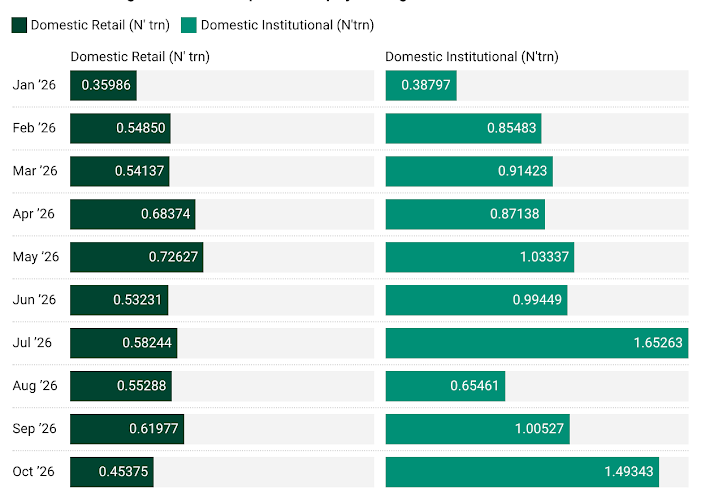
A breakdown showed that domestic institutional transacted an estimated N9. 86 trillion during the period, representing114.37 per cent increase over N4.6 trillion in 2025, while retail domestic investors sold N5.6 trillion in 10 months of 2026, an increase of 90.3 per cent when compared to N2.94 trillion in 2025.
The report revealed that domestic investors have dominated the Nigerian stock market transactions in recent years, attributable to reforms.
Capital market analysts attribute the said the National Pension Commission’s (PenCom) decision to raise equity limits for pension funds in February 2026, has helped to sustain the market momentum.
The policy impacted injection of fresh liquidity into the stock market last week as the stock price of some blue-chip companies advanced significantly. PenCom had on February 9, 2026, revised investment limits for ordinary shares in RSA Funds I, II, III, and VI-Active.
Equities market investors have e joyed strong returns in the seven months of 2026, with market capitalisation gaining N65.74 trillion.
The market capitalisation that opened for trading for 2026 at N99.376 trillion, gained N65.74 trillion or 66.15 per cent to close October 30, 2026 at N165.114 trillion, while NGX All-Share Index moved to 254,299.49 basis points, about 98,686.46 basis points or 63.42per cent Year till Date growth from 155,613.03 basis points the stock market opened for trading.
The NGX report revealed that foreign investors in 10 months of 2026 transacted N1.66 trillion in the Nigerian stock market, about 17.9 per cent increase over N2. 03 trillion reported in 10 months of 2025.
The report stated that, “Over a 19 years period, domestic transactions increased significantly by 160.83per cent from N3.5560 trillion in 2007 to N9.2747 trillion in 2025; whilst foreign transactions also increased significantly by 329.87per cent from N0.6156 trillion to N2.6475 trillion over the same period. Total domestic transactions accounted for about 78% of the total transactions carried out in 2025, whilst foreign transactions accounted for about 22% of the total transactions in the same period.
“As at October 31, 2026, year-to-date domestic transactions amounted to approximately N15.4631 trillion, representing 90.29 per cent of total market transactions, whilst foreign transactions amounted to approximately N1.6638 trillion, accounting for 9.71 per cent.”
Commenting, the Managing Director of Coronation Asset Management, Aigbovbioise Aig-Imoukhuede, said the Nigeria’s stock market growth so far this year is driven predominantly by domestic capital rather than a resurgence in foreign portfolio investment.”
Aig-Imoukhuede, speaking at the H1 2026 Capital Market Review and Outlook for Second Half said the performance of the Nigerian Exchange (NGX) reflected stronger domestic participation, improving macroeconomic conditions and rising investor confidence, rather than significant foreign capital inflows.
He said the changing composition of market participation was one of the most significant features of the 2026 rally.
According to him, domestic investors have become the dominant force behind the market’s performance, even as foreign participation has declined.
Aig-Imoukhuede, however, said the decline in foreign participation should not be interpreted as a complete withdrawal of international investors from Nigeria.
He attributed part of the foreign investors’ positioning to the attractiveness of short-dated Nigerian government securities, which offered yields close to 20 per cent.
“From a pure risk-adjusted perspective, that allocation decision was understandable,” he said.
He identified domestic institutional investors, particularly pension funds, as important contributors to the equities rally following changes to investment thresholds by the PenCom.
The resurgence in domestic retail participation also contributed significantly to the market’s performance, reinforcing what he described as a structural shift in the investor base.
He rejected concerns that increased domestic participation represented a weakness for the market, arguing that a market supported by domestic savings could become more resilient over time.
“If anything, this is a sign of market maturity. Markets become more resilient when they are supported by savings rather than speculation,” he said.