Africa’s startup hangover deepens as boom-era companies struggle to raise again
Africa’s startup ecosystem is confronting a difficult reckoning from the venture capital boom of 2021 and 2022, as hundreds of companies that secured early-stage funding during the period struggle to attract fresh investment, sustain expansion or transition into profitable businesses.
The funding drought is exposing a growing weakness in the continent’s technology economy: raising seed capital no longer guarantees access to subsequent investment, even for businesses that have developed products, acquired customers and established operations. For many startups, the challenge is no longer how quickly they can scale but whether they can survive long enough to secure another funding round.
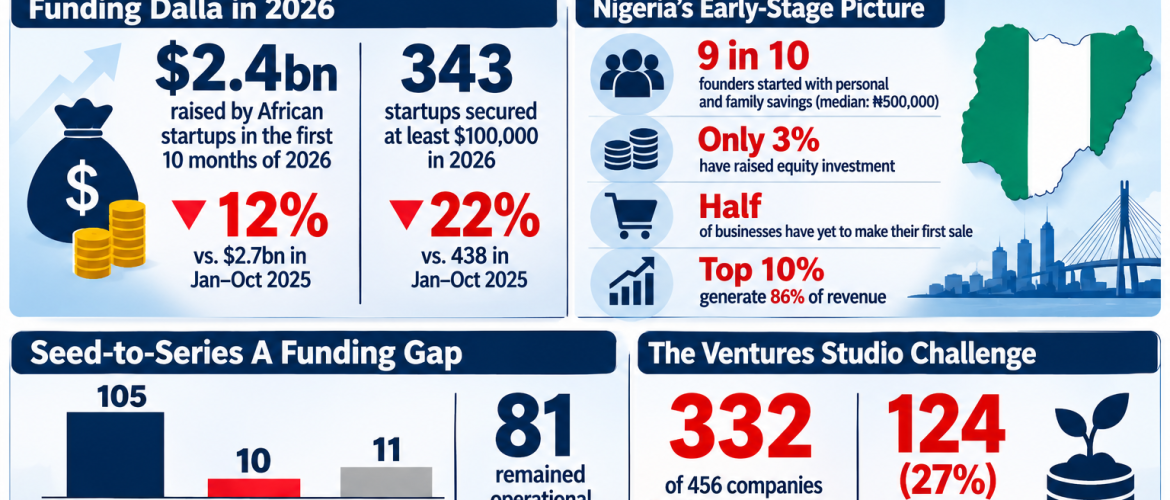
The problem extends beyond individual companies. BusinessDay reports that African startups raised approximately $2.4 billion in the first ten months of 2026, representing a 12 percent decline from the corresponding period in 2025. The number of startups securing at least $100,000 fell 22 percent to 343, the lowest January-to-October figure since Africa: The Big Deal began tracking funding deals of that size in 2021.
The decline in the number of funded companies, despite the billions still flowing into the ecosystem, suggests that capital is increasingly concentrated among a smaller group of established businesses. This creates a difficult environment for early-stage founders seeking to demonstrate traction, particularly as investors become more cautious about business models dependent on continuous fundraising rather than sustainable revenue.
Read also: Nigeria’s startup economy runs on N500,000 family savings as equity funding reaches just 3%
For instance, a new study by Magna Collective, which analysed more than 24,000 early-stage businesses across all 36 states and the Federal Capital Territory in Nigeria, found that nine in 10 founders started their businesses with personal and family savings, with a median initial investment of just N500,000.
Only three percent had secured equity investment, highlighting how most businesses are built without venture capital. “Nigeria does not have a shortage of founders. It has a shortage of first customers,” Femi Awoniyi, managing partner at Magna Collective told BusinessDay.
The study also found that half of the businesses surveyed had yet to make their first sale, while the top 10 percent accounted for 86 percent of total revenue. This suggests that the funding crisis is not simply about investors withdrawing capital but also about the difficulty many businesses face in turning products into paying customers and generating consistent revenue.
According to Awoniyi, the missing link is a stronger bridge between starting a business and achieving steady sales, supported by paying customers, distribution networks and capital suited to the needs of early-stage businesses.
The consequences are becoming more visible in markets such as Kenya, where several previously well-funded startups have collapsed or entered administration. Dealroom data showed that 13 venture-backed Kenyan companies that failed or entered administration had collectively raised approximately $718 million. Among them were Twiga Foods, which raised about $185 million before entering administration in 2026, and Copia, which raised approximately $123 million before moving from administration into liquidation.
The remaining cohort of 13 failed startups includes high-profile ventures such as Gro Intelligence ($117.7 million raised), KOKO Networks ($100 million raised, entered administration in February 2026), Mobius Motors ($56 million), MarketForce ($42.5 million), WeFarm ($32 million), Sendy ($24.7 million), iProcure ($17.2 million), and Lipa Later ($16.6 million).
Ecosystem analyses confirm that these collapses were largely driven by unsustainable scaling, high cash burn on logistics and subsidies, and weak unit economics built on the assumption of cheap, continuous venture capital.
As global investment conditions tightened, Kenyan startup funding dropped from $227 million in the first half of 2025 to $126 million in the first half of 2026, with investors shifting away from aggressive expansion toward immediate revenue and clear paths to profitability.
The scale of capital lost to these failures illustrates the risks associated with the expansion strategies pursued during the boom years. Several companies built operations around aggressive customer acquisition, geographical expansion, subsidies and large workforces, assuming that subsequent funding rounds would remain accessible. When investment conditions changed, the cost structures and cash requirements of these businesses became increasingly difficult to sustain.
For investors, the shift has also changed how startup performance is assessed. Revenue growth, customer numbers and geographical reach are no longer sufficient indicators of business strength when companies cannot demonstrate a credible route to profitability. Investors are increasingly scrutinising cash burn, unit economics, operating efficiency and the ability to generate revenue without relying on fresh capital.
For instance, cohort data compiled by Condia, an African technology publication showed that of the 105 African startups that raised seed funding in 2022, only 10 had progressed to Series A within 34 months. Eleven had either shut down or been acquired, while 81 remained operational without securing additional equity funding.
The findings point to a widening funding gap between companies that entered the market during the investment boom and the smaller pool of businesses now attracting institutional capital. Although many of these startups remain active, their inability to raise follow-on funding raises questions about their capacity to finance expansion, retain talent and meet investor expectations without repeatedly returning to the market.
Benjamin Dada, founder and publisher of Condia, said the cohort analysis was intended to examine what happened to companies that raised funding several years earlier rather than focusing exclusively on annual fundraising totals.
According to Dada, the findings challenge the perception that a recovery in aggregate funding necessarily translates into improved financing opportunities for startups across the continent.
Seed funding activity has also weakened considerably. The number of African startups raising seed rounds declined from 105 in 2022 to 42 in 2025, while the median period between seed funding and Series A increased from approximately 18 months to 29 months.
The longer fundraising cycle has significant implications for founders who previously structured their businesses around 18 to 24 months of operating runway. Companies that cannot raise their next round within that period risk approaching investors with depleted cash reserves, weaker bargaining positions and limited room to negotiate valuations.
Eunice Ajim, founding partner of Ajim Capital, has advised founders to plan for longer fundraising timelines, warning that the traditional assumptions around startup financing no longer reflect market realities.
Her recommendation that founders allow approximately 30 months between seed and Series A highlights the growing importance of capital efficiency. Startups must now demonstrate that they can extend their runway, prioritise commercially viable operations and generate sufficient revenue to support growth while fundraising conditions remain uncertain.
The experience of Chipper Cash, one of Africa’s most prominent venture-backed fintech companies, illustrates how even businesses that attracted substantial investment have had to adjust to the new funding environment.
The company reached a peak valuation of approximately $2.2 billion in 2021 after raising hundreds of millions of dollars. However, changing investment conditions and difficulties within its funding environment forced the business to undertake multiple restructurings as it sought to reduce costs and improve operational efficiency.
In early 2026, co-founder and chief executive Ham Serunjogi disclosed that the company recorded its first quarter of positive free cash flow in the final quarter of 2025. He attributed the progress partly to difficult decisions, including workforce restructurings over the preceding two years.
Chipper Cash’s experience demonstrates that the ability to attract substantial venture capital does not necessarily translate into a sustainable business. For companies that expanded rapidly during the boom, achieving financial discipline has become as important as customer acquisition and market penetration.
The changing investment environment is also reflected in broader private capital activity. The African Private Capital Association has documented a market in which deal volumes have softened, while investment value is increasingly concentrated in larger transactions. This suggests that investors are not necessarily withdrawing entirely from Africa but are becoming more selective about the companies and sectors receiving capital.
The distinction is important for the continent’s startup ecosystem. A market can record billions of dollars in annual funding while a significant proportion of its early-stage businesses struggle to raise relatively modest amounts. Consequently, headline funding growth may conceal a deteriorating financing environment for smaller companies that lack established revenue streams or proven business models.
For African founders, the implications extend beyond securing another investment round. Companies may have to accept lower valuations, reduce their workforce, abandon expansion plans, sell parts of their businesses or transition towards leaner, revenue-driven operations.
Others may continue operating without additional institutional funding, effectively becoming smaller businesses than originally envisaged. Some are likely to close as their financial obligations become unsustainable.
The longer-term concern is whether the funding difficulties facing this cohort will discourage new entrepreneurs and investors from entering the ecosystem. If companies that secured capital during the boom cannot demonstrate viable routes to growth, investors may become even more cautious about backing unproven founders, potentially reducing the pipeline of new businesses.
Read also: FG backs eight startups through iDICE Growth Lab to access N1bn in equity funding
Africa’s venture capital market is therefore facing a test that goes beyond how much money it can attract annually. Its sustainability will increasingly depend on whether funded companies can convert investment into durable businesses, generate consistent revenue and survive without depending on successive rounds of external capital.
The 2021–22 boom expanded the continent’s startup ambitions and brought international investors into markets that had previously struggled to attract significant venture funding. The current correction is exposing the weaknesses beneath that expansion, particularly among companies that built their growth strategies around the expectation of continuous capital availability.
For the majority of startups still waiting for their next round, the central question is no longer how much they can raise but whether their businesses can survive long enough to raise again.

Royal Ibeh is a senior journalist with years of experience reporting on Nigeria’s technology and health sectors. She currently covers the Technology and Health beats for BusinessDay newspaper, where she writes in-depth stories on digital innovation, telecom infrastructure, healthcare systems, and public health policies.