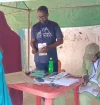
INEC mock accreditation records large turnout in Lagos, voter apathy in Ekiti

The Independent National Electoral Commission (INEC) mock accreditation exercise recorded a large turnout of voters in Lagos State on Saturday, November 28, while voter apathy marred participation in Ekiti State, raising concerns about citizens’ involvement ahead of the 2027 general elections.
In Lagos, the exercise was hitch-free, with voters expressing satisfaction with the early arrival of electoral officials, seamless accreditation process and efficient performance of the Bimodal Voter Accreditation System (BVAS).
They, however, urged INEC to ensure that the experience recorded during the mock exercise was replicated during the actual elections to prevent technical hitches and delays.
At Polling Unit 009, Ward 09, Agnes Street Primary School, Yaba, in Lagos Mainland Local Government Area, voters described the process as orderly and efficient.
One of the participants, Bidemi Adeboye, said he arrived at the polling unit at 8:00 a.m. and met INEC officials already on ground. He added that the accreditation and voting processes were completed within two minutes.
“I have been here since 8:00 a.m., and I met the INEC officials on the ground. I cast my vote,” he said.
Similarly, at Ward K, Polling Unit 002, All Saints Anglican Primary School, Yaba, the exercise proceeded smoothly, with voters attended to by electoral officials. The average time for accreditation and voting was between one and two minutes.
Police personnel, monitors from YIAGA Africa, party representatives and other stakeholders were also present to observe the exercise.
The Chairman of Igando-Ikotun Local Council Development Area, Hon. Lasisi Ayinde Akinsanya, also led residents and other participants in the mock exercise at Polling Unit 005, Egan Town Hall.
The exercise was conducted without difficulty, with INEC recording 50 participants at the polling unit as of 2:33 p.m., comprising 49 successful voters and one void vote.
Meanwhile, the situation was different in Ekiti State, where voter apathy marred the mock accreditation and voting exercise.
Findings by the Sunday Tribune in major towns across the state showed poor turnout at several polling centres in Ado-Ekiti, the state capital, with electoral officials left waiting for voters who largely failed to show up.
At Ward 5, Units 006 and 008, located at the palace of the Ewi of Ado-Ekiti, INEC officials were seen seated with their equipment, awaiting prospective voters.
A similar situation was observed at Ward 4, Unit 009, in the Oke Bola area, and Unit 007, around Poly Bus Stop, Ijigbo Roundabout, where only a handful of voters participated despite the locations being easily accessible.
At Ward 6, Units 005 and 008 in Okeyinmi, turnout was equally low, with officials waiting for hours amid little or no voter presence.
Although the BVAS machines were deployed and ready for use, the exercise was largely devoid of the queues and enthusiasm usually associated with electoral activities.
Some INEC officials, who spoke on condition of anonymity, described the turnout as disappointing and far below expectations, even for a mock exercise.
At the Ewi’s palace polling centre, a trader attributed the apathy to residents’ perception that the outcome of elections was predetermined.
Another resident, John Folayan, said voter apathy had remained a recurring feature of elections in Ekiti, noting that many eligible voters often stayed away from polling centres, even on election days, to attend to their businesses or travel.
He attributed the trend to voters’ disappointment with governance, arguing that electoral participation had not translated into improved roads, employment opportunities or better living conditions.
Ogundana also cited fear of violence, distrust in the electoral process and the perception that votes do not count as factors discouraging participation.
Observers warned that the poor turnout in Ekiti could point to challenges INEC might face in mobilising voters for the 2027 general elections. They called for sustained voter education and efforts to rebuild public confidence in the electoral process.
The mock exercise, conducted across the 36 states of the federation and the Federal Capital Territory, was designed to test the efficiency of the electoral process, particularly voter accreditation and electronic transmission of results, ahead of the 2027 general elections.
WATCH TOP VIDEOS FROM NIGERIAN TRIBUNE TV