Lekki port delays trap exporters’ cash in unshipped cargo
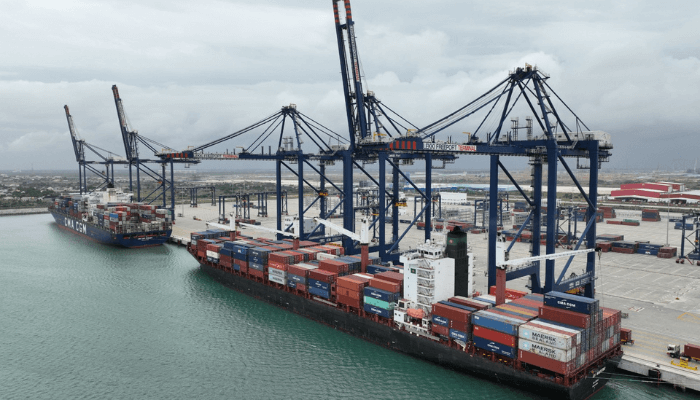
Hundreds of millions of naira are trapped in cargoes at Lekki Deep Sea Port as shipping lines leave behind booked export containers, with some shipments waiting months for space on departing vessels.
Exporters blame the delays on carriers loading only a fraction of the export cargo available, which is driving up storage costs, tying down working capital and threatening losses for businesses shipping perishable goods.
Olubunmi Olumekun, president of the Association of West African Exporters and Maritime Professionals, said the problem was less about vessel shortages than the volume of export cargo ships take away.
“A vessel could discharge 1,000 containers and only carry 200 to 300 boxes,” he said.
Read also: Nigeria begins N746bn-backed rehabilitation of Apapa, Tin Can Island ports
Nigerian Ports Authority (NPA) data show that shipping lines moved 83,167 twenty-foot equivalent units (TEUs) of imports through Lekki in the first half of 2026, compared with 52,407 TEUs of exports.
The delays have surprised exporters who turned to Lekki Port for its deep-water capacity and modern equipment, which attracted large container ships serving Asian and European markets after the facility began full operations in 2023.
The port has since exceeded its annual handling capacity of 1.2 million TEUs, according to the NPA. However, the growing volume of cargo has left exporters struggling to secure space for their containers on departing vessels.
“In 2024 and 2025, I could gate in my container on Friday, and the vessel arrived and loaded it on Saturday. But now you spend about two weeks and then have to wait for a vessel,” said Oladapo Komolafe, an exporter.
Lekki Freeport Terminal is yet to respond to BusinessDay’s request for comment. The port’s master plan includes a second phase that would expand its handling capacity to 2.5 million TEUs, but construction has yet to begin.
Olumekun said he suspects that vessels are deliberately loading below their potential capacity at Lekki. Large ships arriving from Asia and Europe also call at other West African ports as part of regional coastal shipping routes.
Because of Lekki’s 16.5-metre draft, large vessels can arrive carrying heavy import cargoes. They then discharge thousands of containers to reduce their weight and raise their clearance above the waterline, allowing them to enter shallower regional ports that cannot accommodate ships of comparable size.
Foreign shipping lines largely determine their own cargo allocations, while Nigeria lacks an active indigenous ocean-going fleet to provide greater control over international shipping capacity.
“It is impossible to control what you don’t own,” said Jonathan Nicol, an industry expert and former president of the Lagos State Shippers’ Association.
Exporters bear additional costs when carriers fail to load their agreed cargo volumes. The terminal provides 10 free storage days, after which Komolafe said charges rise to N2,600 per day for a 20-foot container and N3,200 for a 40-foot container.
The Nigerian Ports Economic Regulatory Agency (NPERA), formerly the Nigerian Shippers’ Council, is responsible for addressing complaints and protecting the commercial interests of port users.
However, the agency told BusinessDay it was unaware of the problem and would only intervene after receiving formal complaints.
“Once the complaints are filed, we will take it up with the shipping companies,” said Juliana Saka, head of the agency’s complaints unit.
Exporters are considering asking the regulator to press shipping lines to provide dedicated vessel services, allowing larger ships to call directly at Lekki and clear the accumulated export cargo, Olumekun said.
The delays pose particular risks to agricultural exporters, whose products account for about half of Nigeria’s non-oil exports. Nicol said goods with short shelf lives could deteriorate while waiting for shipment, particularly when exporters cannot secure refrigerated containers.
Port growth exposes infrastructure constraints
The congestion is also spilling onto surrounding roads, adding another layer of cost to exporters and other businesses operating around the port.
Lekki Port benefited from shipping disruptions linked to the war in the Middle East, particularly because of its proximity to the Dangote refinery in the Lekki Free Trade Zone.
Disruptions to major oil supplies in the Middle East redirected demand towards alternative fuel suppliers, including Nigeria, where the $20 billion refinery had reached its full capacity of 650,000 barrels per day.
In the first half of 2026, Lekki Port handled 46 percent of cargo throughput across Nigeria’s six operating ports, including Apapa and Tin Can Island. About 76 percent of that cargo traffic was generated by Dangote refinery operations, according to NPA data.
The surge in activity has exposed the limitations of the port’s road infrastructure. The Lekki-Epe Expressway, its main access corridor, has struggled to cope with growing industrial activity. Trucks serving the port reportedly spend hours, sometimes days, on the road because of gridlock.
Rising trade driving gridlock
Vessel turnaround time at the port also increased from 2.1 days to 3.3 days within a year, according to the NPA.
Frank Ojadi, a professor of supply chain management and logistics at Lagos Business School, said the gridlock was a natural consequence of rising trade activity.
The refinery transports much of its petroleum products by road, the port generates substantial container traffic, while the same access corridor also serves commuters.
“As the utilisation of that port continues to increase, which is bound to happen, then you would run into situations where it would be difficult to really move efficiently, and that means we are reverting to what we left at Apapa,” he said.
Reports describe trucks occupying both sides of the road, attempting unauthorised routes and, at times, driving against traffic. The NPA has said trucks turned back at the port gate have repeatedly attempted to re-enter through unauthorised routes.
Sani Bala, national secretary of the Association of Maritime Truck Owners, said the union had written to its drivers to comply with traffic regulations, although he did not say whether its members were involved in the reported disruptions.
At an October stakeholders’ meeting, Emmanuel Anda, the NPA’s port manager at Lekki, directed truck operators to keep to a single lane and comply with the electronic truck call-up system.
Stakeholders also raised concerns about the underuse of designated truck parks, with some operators reportedly obtaining call-up tickets before arriving at the facilities.
Ajay Tyagi, chief operating officer of Lekki Freeport Terminal, said the terminal had introduced a one-container, one-booking rule to prevent duplicate truck bookings. It also plans to deploy radio-frequency identification technology to improve access control and reduce turnaround times.
Stakeholders agreed to inspect the truck parks, while the Lagos State Government said it was developing an enforcement plan.
Ojadi said authorities needed a more systematic understanding of vehicle movements and recommended automated traffic counts to identify pressure points along the corridor.
“There is no quick fix,” he said, warning that logistics inefficiencies could also fuel inflation as businesses transfer higher transport and demurrage costs to customers.
Read also: Foreign exchange shortages push banks’ share of African trade finance down to 23%
Costly alternatives offer limited relief
Although alternative routes and transport options exist, they offer limited relief to exporters and other port users.
Nicol suggested a longer route through Epe, Ikorodu and Ijebu-Ode that could provide an alternative to the expressway, where trucks can spend up to four hours in traffic. However, the longer journey would increase transportation costs.
Barges could also reduce pressure on the roads, although their suitability for operations on the high seas remains uncertain.
“I can’t count any jetties around that Lekki terminal, where you can have barges and things can be taken away easily from them,” he said.
Smaller feeder vessels could transport containers to older Lagos ports, but their limited availability and the additional handling charges involved would increase costs for shippers.

Bethel Olujobi is the Trade Correspondent at BusinessDay. He brings scarce insight into Nigeria’s maritime policies and the changing currents of global commerce defining the country’s position in international trade. Before this, he reported on foreign relations, migration and sports for BusinessDay. He holds a Bachelor’s degree in Mass Communication, and is an alumni of the CNN Academy and the Financial Times News School. He is certified by Reuters and Google. He is based in Lagos, Nigeria.