Naira seen strengthening to N1,360 as CBN lifts parallel dollar market supply
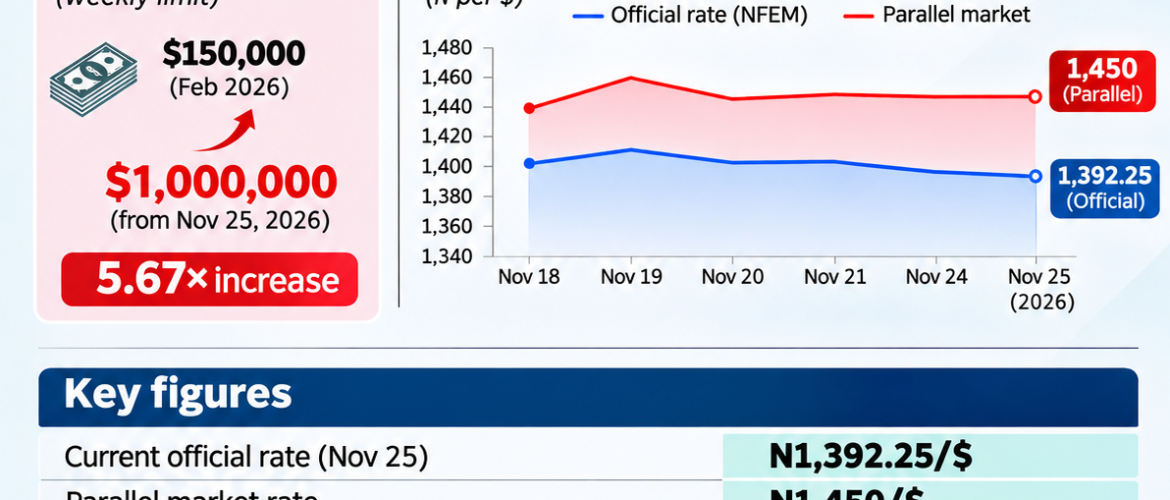
…records gain as apex bank raises BDC dollar cash by 5.67times to $1m weekly
The naira appreciated against the dollar in the official foreign exchange (FX) market on Wednesday following the Central Bank of Nigeria’s (CBN) approval of a $1 million weekly cash allocation for Bureau De Change (BDC) operators through authorised dealer banks.
The new allocation is 5.67 times higher than the $150,000 weekly limit introduced by the apex bank in February 2026, marking a significant increase in physical dollar supply to the retail foreign exchange market.
Data published by the CBN on Wednesday showed that the naira appreciated by N1.87, as the dollar was quoted at N1,392.25, compared with N1,394.12 on Tuesday at the Nigerian Foreign Exchange Market (NFEM), halting the two-week depreciation of the naira.
However, in the parallel foreign exchange market, also known as the black market, the naira remained stable at N1,450 per dollar on Wednesday.
Data collated from parallel market operators showed that the dollar traded unchanged at N1,450, despite the CBN’s new directive aimed at increasing physical dollar supply to the retail segment of the market.
The gap between the official and parallel market rates widened to N58 or 4.17 percent on Wednesday from N56 or 4.02 percent on Tuesday.
Under the new arrangement, which takes effect on Wednesday, November 25, banks are authorised to sell up to $1 million in cash weekly to licensed BDC operators.
The approval significantly increases the amount of physical dollars available to BDCs through the banking system, compared with the previous arrangement, which restricted cash withdrawals to 25 percent of approved allocations.
The CBN communicated the approval to banks through an email, authorising them to increase dollar cash sales to BDC operators. The apex bank is also expected to provide additional cash liquidity to banks where necessary to facilitate the transactions.
Read also: Naira holds at N1,450 as CBN opens $1m cash window for BDCs
Aminu Gwadabe, president of the Association of Bureau De Change Operators of Nigeria (ABCON), welcomed the development, describing it as a positive step towards improving liquidity in the retail foreign exchange market.
He said the BDC subsector remained a potent channel for transmitting the CBN’s foreign exchange policies, particularly in addressing liquidity challenges at the retail end of the market.
According to him, the increased cash allocation would inject significant liquidity into the market and help moderate the exchange rate volatility recently experienced, particularly in the parallel market.
Gwadabe said banks had already started reaching out to BDC operators to facilitate the transactions, while the CBN had undertaken to meet banks’ cash requirements to ensure adequate dollar availability.
He called on the CBN to accelerate the approval process for operators awaiting approval in principle to encourage wider participation in the market.
Ayodeji Ebo, chief executive officer of MDU Capital, said the CBN’s intervention was timely, given the recent pressure on the naira from increased year-end demand for dollars.
He said granting licensed BDCs greater access to dollar cash through banks would make it easier for travellers and other retail customers to access foreign currency, thereby easing pressure on the parallel market and helping narrow the gap between official and informal exchange rates.
“My near-term outlook is for a steadier naira, with room for modest gains in the parallel market if banks supply BDCs consistently. Election-related spending could add to dollar demand and limit those gains,” he said.
Ayodele Akinwunmi, chief economist at United Capital Plc, said, “This is expected to increase the supply of US dollars in the foreign exchange market, potentially supporting further appreciation of the Naira towards the N1,360/US$ region.”
Read also: Naira trades flat after CBN rate hold as FX turnover hits record $1.97bn
However, he said the extent of this appreciation will depend largely on whether Foreign Portfolio Investors (FPIs) have completed the liquidation of their securities holdings and the repatriation of proceeds as they exit the market.
Razia Khan, managing director and chief economist for Africa and the Middle East at Standard Chartered Bank, also attributed the recent pressure on the naira largely to seasonal factors.
Khan said the CBN appeared unfazed by the currency’s recent weakness, noting that the estimated $300 million decline in external reserves was manageable.
She also highlighted Nigeria’s healthy current account surplus and the recent memorandum of understanding between the CBN and the Nigerian National Petroleum Company Limited (NNPC), which is expected to support foreign exchange inflows and further accumulation of external reserves.
Speaking at the last Monetary Policy Committee meeting of 2026, Olayemi Cardoso, CBN governor, assured Nigerians that the apex bank would continue to take necessary measures to sustain financial system stability.
He disclosed that Nigeria’s gross external reserves stood at $54.02 billion as of November 17, 2026, providing approximately 10.26 months of import cover for goods and services.
The latest directive comes as the CBN seeks to sustain exchange rate stability and improve dollar availability across the foreign exchange market.
In February 2026, the apex bank reopened access to the official foreign exchange market for licensed BDC operators in a move aimed at improving dollar liquidity in the retail segment and curbing persistent pressure in the parallel market.
In a circular dated February 10, the CBN said duly licensed BDCs could purchase foreign exchange from the NFEM through any authorised dealer bank of their choice at prevailing market rates.
The arrangement allowed authorised dealer banks to sell foreign currency to BDCs for eligible retail transactions, subject to a weekly limit of $150,000 per operator.
In September 2025, the CBN confirmed that 82 BDC operators had been fully licensed to commence operations from November 27 under its renewed regulatory framework for the foreign exchange market.
Under the framework, authorised dealer banks are required to conduct full know-your-customer checks and due diligence on BDC clients in line with regulatory requirements and internal risk-management policies.
The apex bank said the policy was designed to ensure adequate foreign exchange supply to meet the legitimate needs of end users, particularly for retail transactions, following renewed naira volatility and widening spreads between official and informal market rates.

Hope Moses-Ashike is an Associate Editor, Banking and Finance, with more than a decade of experience reporting on Nigeria’s financial system and broader economy. She closely tracks market movements, monetary policy decisions, company disclosures, regulatory actions, economic indicators, and global developments, and interprets what they mean for businesses, investors, policymakers, and households. Her reporting helps readers understand complex issues such as inflation trends, foreign exchange market dynamics, interest rate decisions, bank performance, and investment risks.
She also covers major international events and periodically travels to Washington, D.C., to report on the World Bank/IMF Spring and Annual Meetings.
Her dedication to financial journalism has earned her multiple recognitions and invitations to high-level professional development programmes. She is an alumna of the International Visitors Leadership Programme (IVLP) in the United States and holds an Advanced Financial Journalism Certificate from the Press Association Training in London, UK. Her other notable achievements include completing the Lagos Business School CMC Programme, the Bloomberg Media Africa Initiative Programme, and a Master Class in Journalism at Rhodes University in South Africa.