Poor sports infrastructure keeps Nigeria out of $21bn World Cup opportunity
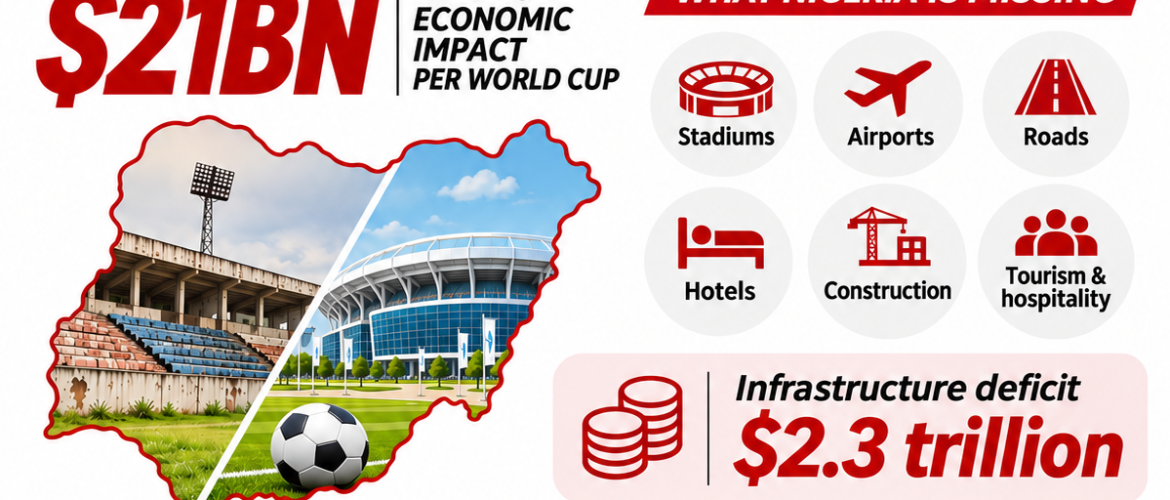
Nigeria’s inadequate sports infrastructure is shutting the country out of the opportunity to compete for FIFA World Cup hosting rights, potentially denying its economy access to an estimated $21 billion in average economic impact per tournament.
Weak stadium infrastructure, inadequate airports, poor transport networks and insufficient hospitality facilities remain major obstacles for Africa’s most populous nation.
Nigeria is widely regarded as Africa’s largest football market by fan base and viewership, driven by its large population and strong engagement across mobile, digital and communal viewing platforms.
During a recent visit to Nigeria, Gianni Infantino, FIFA president, said the country currently lacks the infrastructure required to host football’s biggest competition. He also highlighted the scale of investment and long-term planning needed to meet the tournament’s demanding requirements.
Read also: Nnadozie, Oshoala headline Super Falcons squad for Algeria friendlies
Nigeria faces an estimated $2.3 trillion infrastructure deficit, compounded by declining oil revenues, abandoned projects and corruption in public spending, according to analysts.
World Cup hosts record average $21bn economic impact
Hosting the FIFA World Cup can inject billions of dollars into an economy, creating business opportunities across construction, tourism, hospitality, aviation, transport, retail and entertainment.
A BusinessDay analysis of the last six tournaments, from Germany in 2006 to the 2026 competition jointly hosted by the United States, Canada and Mexico, puts the average economic impact at approximately $21 billion per tournament.
Beyond the millions of supporters who travel to watch matches, host countries attract international media, sponsors, corporate delegations and investors.
Their spending supports hotels, restaurants, airlines, transport operators and other businesses, while preparations for the competition can accelerate investment in stadiums, roads, airports and urban infrastructure.
The figures from previous tournaments illustrate the scale of the opportunity. Germany’s 2006 World Cup generated an estimated €3.8 billion in additional GDP across 2006 and 2007, equivalent to about $4.8 billion at the time. The assessment examined the tournament’s effects on spending, investment, trade, employment and tax revenue.
South Africa’s 2010 tournament was estimated to have generated R93 billion, or approximately $12.7 billion, in gross economic impact, according to Grant Thornton.
The estimate included infrastructure spending, tournament operations and tourism-related activity. Foreign visitors who travelled specifically for the competition also spent an estimated R3.6 billion in the country, supporting hotels, restaurants, transport operators and other tourism businesses.
Brazil’s 2014 World Cup generated an estimated $70.5 billion in additional production of goods and services, according to research by Ernst & Young and Fundação Getulio Vargas.
The study captured the direct, indirect and induced effects of tournament-related spending across the economy. A separate government assessment put additional production at R155.7 billion, with associated tax revenue estimated at R16.1 billion.
Russia’s 2018 tournament contributed an estimated 952 billion roubles to GDP between 2013 and 2018, equivalent to approximately $14.5 billion at the time. An assessment published by the Russian Football Union also estimated that the competition supported up to 315,000 jobs annually during the period, reflecting the economic activity generated by preparations and hosting.
For Qatar, the 2022 World Cup generated between $1.6 billion and $2.4 billion in gross value added from visitor spending and World Cup-related broadcasting revenue, according to the International Monetary Fund. This represented an estimated 0.7 to 1 percent of the country’s GDP.
The economic opportunity was projected to be considerably larger across the three countries hosting the 2026 tournament. Projections put the contribution to the United States’ GDP at $17.2 billion, Mexico’s at approximately $2.7 billion and Canada’s at $1.4 billion.
Combined, the three economies were projected to receive about $21.3 billion in additional GDP contribution from the competition.
Using these estimates, the six tournaments account for approximately $126 billion in reported or projected economic impact, giving an indicative average of about $21 billion per World Cup.
For Nigeria, the opportunity would extend beyond spending during the tournament. Hosting could create contracts for local construction firms, increase demand for hotels and airlines, expand employment across tourism and services, attract international investment and expose the country to a global television audience.
It could also accelerate investment in transport, hospitality and sporting infrastructure, while creating an avenue for hosting other international sport competitions and becoming a major tourism destination.
Stadium infrastructure remains a major hurdle
The World Cup requires multiple international-standard stadiums, efficient transport networks, adequate hotel accommodation, security systems and supporting facilities capable of accommodating teams, officials, media representatives and millions of supporters.
Abiola Rasaq, former economist and head of investor relations at United Bank for Africa Plc, said Nigeria must first understand the infrastructure benchmarks FIFA considers when assessing prospective host countries.
He identified stadium capacity, transportation networks, hotels, emergency services and security architecture as critical requirements for hosting the competition.
According to Rasaq, stadium capacity remains one of the most important considerations, particularly for opening matches and finals, which attract some of the tournament’s largest crowds.
He cited Qatar’s 2022 World Cup, where the opening match was played at the 68,000-capacity Al Bayt Stadium, while the final between Argentina and France took place at Lusail Stadium, which accommodates nearly 90,000 spectators. Both stadiums were completed in 2021 as part of Qatar’s preparations.
“Imagine having such attendance at a game played in Qatar, a country with less than 3.5 million people. How much more if a World Cup is being hosted in Nigeria, with a population of over 220 million people and a strong football appetite?” Rasaq said.
He argued that Nigeria’s large population and passion for football could generate substantial demand, but the country must first develop the infrastructure to accommodate spectators safely and efficiently.
Ayodeji Adegbenro, a sports administrator and analyst, said Infantino’s assessment reflects longstanding weaknesses in Nigeria’s sports infrastructure that successive administrations have failed to address.
He noted that the expansion of the World Cup from 32 to 48 teams has significantly increased the requirements for prospective hosts, with the tournament demanding multiple stadiums, host cities and extensive supporting facilities.
“To host a 48-team World Cup, you probably need up to eight stadiums and eight venues,” Adegbenro said.
He argued that Nigeria currently has very few stadiums meeting CAF requirements, while several existing facilities remain unsuitable for a tournament of FIFA’s scale.
“We’ve allowed that infrastructure decay to a level where we really have one good venue in Nigeria, which is embarrassing, to say the least,” he said.
Transportation and hospitality gaps
Beyond stadiums, transportation is another major obstacle to Nigeria’s World Cup ambitions, particularly the capacity of domestic airports and airlines to manage the movement of thousands of spectators between host cities.
“Our air transportation system is evolving very fast but still lacks the capacity to accommodate about 40,000 people travelling on the same day, at the same time, to see a match,” Rasaq said.
He added that domestic airlines and airports would require significant upgrades, alongside improvements in road transportation and last-mile connectivity.
Nigeria’s hospitality industry also faces capacity constraints, with quality hotel accommodation concentrated in a handful of cities, including Lagos, Abuja and Port Harcourt.
Rasaq questioned whether these cities could accommodate a sudden influx of tens of thousands of international visitors, citing the difficulty of securing hotel reservations in Abuja during major national conferences and political party conventions.
“Can these cities host a surge of 50,000 people at once? If you have ever tried to book a good hotel in Abuja during some national conferences that have just 5,000 people in attendance, you would know we are not there yet,” he said.
He also identified hotels, airports, transportation networks and connectivity between host cities as critical requirements Nigeria has yet to adequately develop.
The cost of hosting a World Cup
While the potential economic benefits are substantial, hosting the World Cup requires enormous financial commitments, raising questions about whether Nigeria’s current economic realities can support the investment.
Rasaq pointed to Qatar’s estimated $220 billion infrastructure expenditure associated with the 2022 World Cup, which covered stadiums, roads, hotels, transportation networks and wider urban development.
He compared the estimated construction costs of two major Qatari stadiums with the funding allocated to some of Nigeria’s largest infrastructure projects.
Al Bayt Stadium reportedly cost approximately $850 million, while Lusail Stadium cost about $770 million, bringing their combined construction costs to approximately $1.62 billion.
Rasaq contrasted this with the Lagos-Calabar Coastal Highway, one of Nigeria’s largest ongoing infrastructure projects, which he put at slightly above $10 billion.
“What would the argument be if the government were to commit about $1.6 billion to building two stadia like the Al Bayt and Lusail in Qatar?” he asked.
He argued that Nigeria must carefully assess competing development priorities before committing public resources to a World Cup hosting project.
Nigeria must start with AFCON
Adegbenro argued that Nigeria’s immediate ambition should not be hosting the World Cup when the country still faces challenges meeting the requirements for staging the Africa Cup of Nations (AFCON).
He said the expansion of the World Cup and the infrastructure requirements for multiple host cities make the competition an even more distant prospect for Nigeria.
“As of today, we can’t even host AFCON. AFCON is a 24-team tournament, and we cannot host it. So why are we talking about hosting a World Cup?” he asked.
Nigeria last hosted AFCON in 2000, when it co-hosted the competition with Ghana. Its last standalone hosting was in 1980, 46 years ago.
Drawing on his experience covering the 2018 World Cup in Russia and the 2022 tournament in Qatar, he said international sporting events can strengthen tourism and create business opportunities long after competitions have ended.
“I was in Russia for the 2018 World Cup and Qatar for the 2022 World Cup. I was so impressed with Qatar that I went back for a vacation. When people come and love your country, they will come back,” he said.
He pointed to Morocco’s hosting of the 2025 AFCON as another example of the tourism and commercial opportunities available to countries that invest in sporting infrastructure.
Read also: FIFA confirms cyberattack, says personal and business data stolen
World Cup investment could create jobs, attract businesses
Despite the financial and infrastructure challenges, both analysts highlighted the potential for major sporting events to attract private investment, create employment and stimulate business activity across host cities.
Adegbenro explained that preparations for a World Cup could encourage investors to develop hotels, transportation systems, restaurants and commercial facilities to meet increased demand.
Using Ibadan as an example, he said including the city among potential host locations could expose gaps in its hospitality infrastructure and encourage private-sector investment.
“If FIFA comes down and tells you that you don’t have enough five-star hotels in Ibadan, then people will have to build hotels in Ibadan. But when the tournament is done, you won’t move the hotel. The hotel will still be there to serve the local populace, and they will hire staff,” he said.
He added that improved transport infrastructure would facilitate movement between host cities, stimulate commercial activity and create additional revenue opportunities for local businesses.
Qatar’s underground railway system, developed as part of its World Cup preparations, illustrates how infrastructure investments can continue serving residents after a major sporting event.
“The railway is still there, it’s still running, it’s still functioning, and it’s still serving the people of Qatar,” Adegbenro said.
Nigeria last hosted a FIFA tournament in 2009, when it staged the FIFA U-17 World Cup. South Africa remains the only African country to have hosted the men’s senior World Cup in 2010, while Morocco will co-host the 2030 edition alongside Spain and Portugal.
For Nigeria, the challenge extends beyond building world-class stadiums. It requires sustained investment in airports, roads, hotels, security and other supporting infrastructure, backed by a long-term development strategy.
As Rasaq noted, Nigeria could gradually meet FIFA’s hosting requirements if infrastructure development is aligned with the country’s economic realities and priorities.
“As we build out our infrastructure, along a well-thought-out master plan that fits into our economic realities and priorities, we would steadily evolve towards meeting that assessment and, in the future, we would be a viable host country, but certainly not yet,” he said.

Head of Sports at BusinessDay Media, a seasoned Digital Content Producer, and FIFA/CAF Accredited Journalist with over a decade of sports reporting.Has a deep understanding of the Nigerian and global sports landscape and skills in delivering comprehensive and insightful sports content.